Indoor ranges rarely advertise it as a headline feature, but ammunition policy has become part of the building’s engineering. What looks like a simple “no steel-core” rule is usually tied to a chain of mechanical and safety concerns that starts at the firing line and ends deep inside the backstop. An indoor range is not just a place to launch bullets down a concrete tube. It is a tightly managed system of bullet traps, ventilation, lead collection, sound control, and maintenance schedules. Once rifle rounds with magnetic jackets or steel content enter that system, the wear pattern changes.
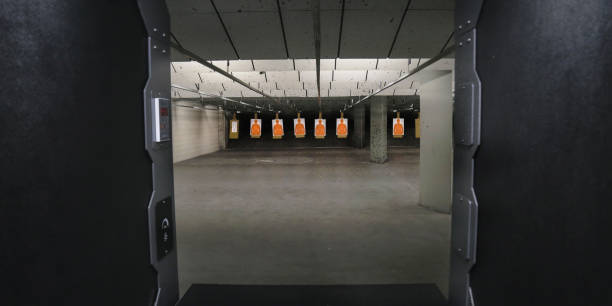
That is why many facilities now treat ammunition almost like a component of the range itself rather than a customer choice. At the center of the issue is the bullet trap. Indoor ranges use capture systems designed around predictable impact behavior, and common designs include steel traps that can handle rifle ammo up to 7.62 and 3,000 fps. Those traps work by redirecting or arresting projectiles in a controlled way, but they are still consumable equipment. A conventional lead-core, copper-jacketed round deforms differently from a projectile with steel in the jacket or core. Even when shooters talk loosely about “steel ammo,” the real problem often is not the case but the projectile’s construction. As one discussion on the topic put it, “Put a magnet to it.” That quick test often reveals a bi-metal jacket that behaves more harshly on steel surfaces than a typical range-safe rifle bullet.
The damage is cumulative rather than dramatic. Steel-bearing projectiles can accelerate pitting on angled plates, increase splash risk, and shorten the service life of expensive trap components. A busy indoor rifle lane can absorb thousands of impacts in short order, so a small difference in bullet hardness becomes a maintenance budget line item. That helps explain why some bans appear broad on paper even when the real target is magnetic or bi-metal projectiles rather than every cartridge with a steel case.
Fire risk is the other half of the equation. Steel striking steel can produce sparks, and indoor bullet traps accumulate fragmented metal, dust, and residue over time. In facilities where fragmented material is continuously collected and removed, the margin for error still depends on housekeeping and airflow. Federal workplace rules on ventilation emphasize that exhaust systems shall be in operation continually and that dust and fumes must be conveyed to safe disposal. Those rules are not written specifically for commercial shooting lanes, but the engineering principle is identical: airborne particulates and residue cannot be allowed to build unchecked in an occupied work area.
That matters because indoor ranges are also contamination-control environments. Bullet traps exist partly to simplify recovery and cleanup and to reduce exposure from accumulated lead and fragments. Ammunition that breaks up differently, sheds harder fragments, or complicates sorting at the reclamation stage adds labor to a system already built around careful collection. Brass-cased ammunition has long fit neatly into that workflow, which is one reason shooters often hear explanations that sound partly about safety and partly about operations. Both are usually true.
The quiet phaseout is less about fashion than facility management. Indoor ranges have learned that ammo rules are cheaper than trap rebuilds, cleaner than emergency maintenance, and easier to enforce than explaining metallurgy at the counter. In that sense, the posted sign is not just policy. It is a shorthand version of the building’s design limits.


