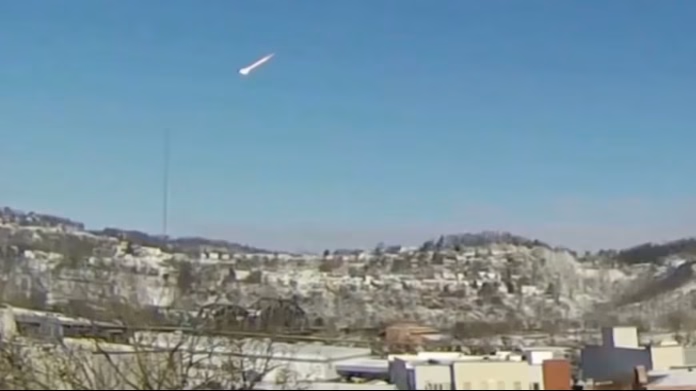
At breakfast time in northern Ohio, a flash crossed a bright morning sky and a deep boom followed behind it. For many residents, the first impression was not astronomy but impact: windows rattled, houses shivered, and a routine weekday suddenly felt uncertain. NASA later identified the object as a meteor roughly six feet across and weighing about seven tons, moving at about 45,000 miles per hour. It first became visible about 50 miles above Lake Erie near Lorain, then tore through more than 34 miles of atmosphere before fragmenting over Valley City. The breakup released energy equivalent to 250 tons of TNT, enough to create the boom heard and felt across parts of the region.
What made the event especially striking was timing. Fireballs are usually associated with dark skies, yet this one was bright enough to be seen in full morning daylight from a vast area stretching from the Midwest to the Mid-Atlantic. The American Meteor Society received reports from multiple states, and imagery suggested the flash was even detected by GOES-19’s Geostationary Lightning Mapper, a reminder that the atmosphere can briefly turn a small asteroid into something visible both from the ground and from orbit.
“This one really does look like it’s a fireball, which means it’s a meteorite a small asteroid,” astronomer Carl Hergenrother said. That distinction matters because modern skies contain plenty of human-made objects. Reentering satellites can also burn overhead, but they usually do not appear this bright. In this case, the speed, brilliance, and pressure wave all pointed to a natural object arriving from space rather than debris returning from orbit.
The boom also hinted at something else: some material may have survived. Meteor observer Robert Lunsford said that when a very large meteor drops into denser layers of air, the resulting sonic boom is often “a good indication that the fireball produced fragments on the ground.” Early trajectory work pointed toward the vicinity of Akron as a possible fall zone, although officials initially reported no confirmed debris. Most of the object almost certainly burned away. Even so, airbursts deserve attention because the atmosphere does not simply erase the hazard; it transforms it.
The modern benchmark is the 2013 Chelyabinsk airburst over Russia, where the meteor itself did not strike people directly, but the shock wave shattered glass across a wide area and sent more than 1,000 people for medical treatment. Ohio’s fireball was far smaller, yet it illustrated the same physics on a gentler scale: light first, sound later, then a spreading realization that a rock no larger than a household appliance can disturb a landscape far below.
Events like this are not as extraordinary as they seem. Hergenrother noted that meteors fall somewhere in the United States about once a day, while smaller dust-sized material reaches Earth far more often. What has changed is visibility. Doorbell cameras, dashboard cameras, security systems, weather satellites, and public reporting networks now turn fleeting sky events into measurable data. “Now we’re seeing them, and there’s dozens of videos popping up all the time,” Hergenrother said. For scientists, that growing archive does more than satisfy curiosity. It makes each sudden flash over a city, suburb, or lake a little easier to reconstruct the next time the daylight sky erupts without warning.


