Around 10,000 muons pass through each square meter of Earth’s surface every minute, creating a natural particle shower that researchers are now using to read the interiors of monuments without cutting into stone.

That quiet stream of cosmic-ray by-products has become one of the most intriguing tools in archaeological engineering. Muons, formed when high-energy cosmic rays strike the upper atmosphere, behave like a naturally occurring radiography beam. Because dense material absorbs more of them than empty space does, detectors can turn tiny differences in muon counts into maps of hidden chambers, tunnels, and structural anomalies inside massive objects.
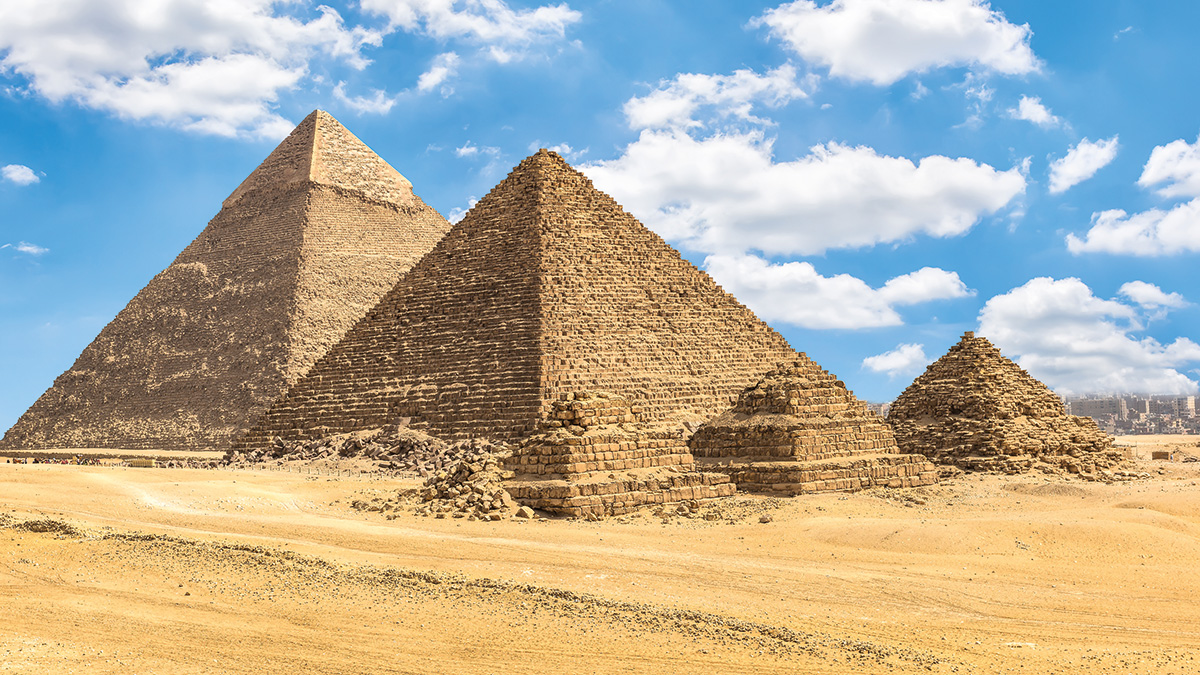
In Egypt’s Great Pyramid, that principle helped identify a large void above the Grand Gallery. The space was reported as at least 30 meters long, making it the first major newly identified interior space there since the 19th century. Researchers in the ScanPyramids effort relied on multiple detector types placed both inside and outside the monument, looking for an excess of muons passing through stone where solid masonry should have blocked them. The agreement among three independent measurements gave the result unusual weight, even as debate continued over what, exactly, the feature represents.
The appeal of the method lies in what it avoids. No drilling campaign is needed to begin the search, and no heavy excavation has to come first. Muon imaging is often compared to X-ray radiography, but on an architectural scale. As the IAEA explains, the technique can reveal density changes deep inside large structures because muons can penetrate hundreds of meters of rock while remaining harmless to people. In archaeology, that makes them especially useful for monuments that are too fragile, too culturally significant, or too geometrically complex for invasive probing. In engineering terms, muography is less about producing a photograph than building a density model from particle traffic, one angle at a time, until voids begin to emerge from the statistical background.
The technology has matured far beyond its early experiments. Muography first entered archaeology in the late 1960s, when Luis Alvarez used detectors to search for hidden spaces in Khafre’s pyramid. Since then, detector systems have become more compact, lower-power, and more precise. A review in muon absorption radiography research describes modern instruments with strong angular resolution and practical field deployment, opening applications well beyond pyramids. In Naples, for example, researchers demonstrated that muography could detect and reproduce the shape of cavities within a dense underground network, showing sensitivity to features only a few meters across through more than 30 meters of rock.
That broader shift is reshaping how buried heritage may be explored. At Jerusalem’s City of David, a 2025 demonstration showed that underground muon imaging at an archaeological site could map concealed spaces by tracking changes in the ground’s absorptivity. The long-term goal is 3D subsurface imaging before excavation begins, allowing archaeologists to understand what lies below a site rather than discovering cavities by chance after digging. Combined with LiDAR, simulation, and improved detectors, cosmic-ray scanning is moving from singular discoveries toward full hidden-space mapping.
Ancient monuments were once opened by force, then studied room by room. Muon imaging offers a different model: let the particles pass through first, and let the structure describe itself.