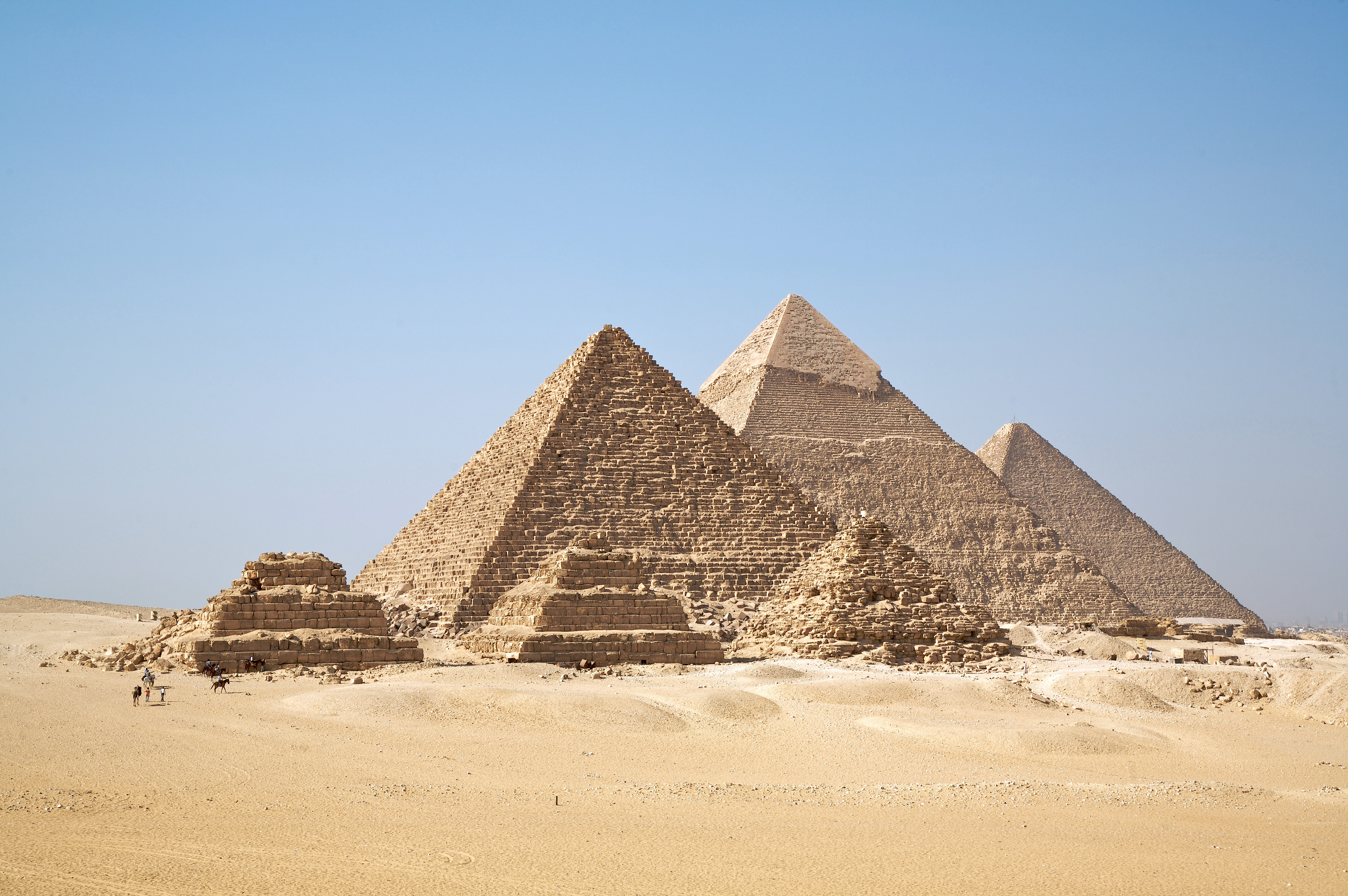
The Great Pyramid has not yielded its secrets by force, but by physics. In the last decade, researchers studying Khufu’s monument have shown that a previously hidden corridor behind the north face chevrons can be identified without dismantling a single stone, using a combination of cosmic-ray muons and other non-destructive imaging tools.

That result matters far beyond the thrill of discovery. Egypt’s pyramids are too important, too fragile, and too complex to investigate with the invasive methods once associated with archaeological breakthroughs. The newer approach treats the structure as both monument and engineering problem: a massive limestone body whose internal geometry can be inferred by measuring density contrasts, wave reflections, and electrical behavior.
At the center of this shift is muography, sometimes described as a kind of natural radiography. Muons are high-energy particles created when cosmic rays strike Earth’s atmosphere. Because they can pass through great thicknesses of stone, detectors placed inside or around a pyramid can measure where more muons arrive and where fewer do. A hidden void leaves a signature because it absorbs less of that particle flow than solid masonry. As the CERN Courier explains, muography has become a powerful way to examine large structures that cannot be opened, and the ScanPyramids mission used multiple detector types to cross-check what the particles were revealing inside Khufu’s pyramid.
The hidden feature on the north face became one of the clearest demonstrations of that method. ScanPyramids refined it as a corridor-like space located between about 17 and 23 meters above ground level and roughly 0.7 to 2 meters behind the north face. Muon observations pointed to the anomaly first, but the most recent engineering work strengthened the case by asking a different question: not just whether a void existed, but what kind of void it was and how it related to the masonry around it. That is where the follow-up survey became especially significant.
Researchers combined three non-destructive testing methods: ground-penetrating radar, ultrasonic testing, and electrical resistivity tomography. Each responds to the pyramid differently. Radar tracks reflected electromagnetic signals. Ultrasound reacts strongly to changes in acoustic impedance, making air gaps especially visible. Electrical resistivity adds something the others cannot by offering volumetric clues, since air is far more resistive than limestone. In the 2025 Scientific Reports study, the team fused these datasets into single composite images, allowing repeated reflectors and resistive anomalies to line up across methods. That alignment supported the conclusion that the feature was not simply a thin joint between blocks, but a significant air-filled void.
The same study also underscored how difficult such work is on an ancient structure. Measurements on the Chevron zone were gathered during campaigns from 2020 to 2022, with scaffolding, custom wooden supports, and carefully spaced scan profiles. The researchers were not peering into an empty chamber from one open doorway; they were reconstructing an inaccessible space through overlapping signals, then checking whether those signals agreed.
Muon imaging itself is part of a much longer scientific story. Luis Alvarez famously tried a similar concept on Khafre’s pyramid in the 1960s and found no hidden chamber there, but the method survived because the principle was sound. Modern detectors, better computation, and larger datasets have turned that early experiment into a practical heritage tool. As the International Atomic Energy Agency notes, muon imaging functions like radiography without an artificial radiation source, relying instead on naturally occurring particles that are completely harmless to people.
For engineers and archaeologists alike, the lesson is becoming clear: the next major revelations inside ancient monuments may come less from excavation than from better sensing. In Khufu’s pyramid, the hidden spaces are no longer only matters of legend. They are becoming measurable parts of a structure that still has more to show.