
The reason why modern missile defense happens to fail faster than any other defense is that it is constructed around one, obvious hub. The engineering issue lurking behind the suggested Trump-class battle ship proposal is to put the magazine, the sensors, and the command capability all in a single very large hull to make survivability a bet against continuous systems integration.
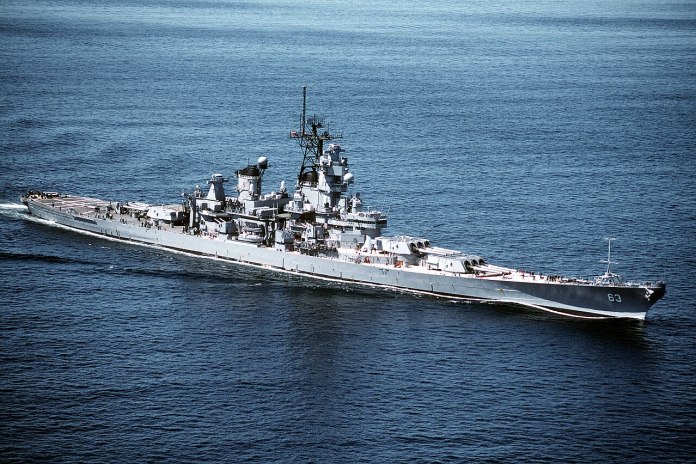
The idea has been packaged by its advocates as a 30,000-40,000-ton core of a “Golden Fleet” of deep missile battery, high-energy lasers, railguns and hypersonic weaponry combined into a command platform. The rationale is also common place: the need to have fewer ships to man, fewer gears in the structure of the fleet, and a capital vessel that appears to be a throwback to maritime confidence. The working environment shifted in the opposite direction. Long-range accuracy shots, continual sensing, and quick targeting rates, punish focus and compensate distributed shooting nodes that can likewise lose a particular amount of fire without deteriorating the capability of the fleet to think and shoot.
The integration risk does not exist in the abstract. The latest case study in what occurs when excessive novelty is introduced into a single hull simultaneously is the Ford-class of the Navy. The program had piled 23 new technologies onto its lead ship; during the program, Adm. Mike Gilday said, it was 23 new technologies on a single ship, which was in fact, more likely to risk the ship failing to deliver on time and cost during the initial stages. The same pattern, but with even more unforgiving combat-system dependencies, would be used in a Trump-class design. DEWs require power and cooling stability, sensor requirements are demanding performance in severe maritime environments, and the combat system must combine information and make engagements within milliseconds. The combat applicability of the platform is dependent on the behavior of the software, electromagnetic performance, and connection to the network when under stress. Practically, a mission-kill may eliminate not just firepower, but the decision making node of the fleet.
That contradiction bangs up against one of the most fundamental tenets that have been applied to Aegis over long run, Don’t have single points of failure, redundancy, graceful degradation, and incremental stages of development. During a CSIS meeting, Rear Adm. Tom Druggan pointed out one of the perennial “Wayne Meyerisms” behind Aegis, namely, “build a little, test a little, learn a lot” and he added, “beware of the single-point failure.” The culture is oriented to maintaining a complicated weapon system at all times, since, according to Druggan, operational availability of 90 percent is horrible. An idea of capital ship which puts fleet protection in a single hull is directly contrary to that rationale, although the vessel itself might have internal redundancy.
The sales pitch is also interred by the magazine math. Discussion by the public of the Trump-class has coupled it to a vertical launch battery with 128 cells. That is big until compared to current workhorses: Arleigh Burke-class destroyers carry 96 cells on about a third of the displacement, and even future work of the fleet in the area of missile defence is already dependent on the number of shooters in the distributed array who can be kept on station and fed. However, leaving cost aside, the reduced number of hulls of similar missile count implies a reduced number of firing nodes, a reduced number of independent radars and combat systems in the formation, and a reduced number of separate targets that will have to be solved by an adversary. The focus makes the targeting of the opponent a simple issue.
Another argument, presented by advocates is that a surface combatant well armed with missiles can act as a deterrent off the carrier-centric assumptions by rendering strike power viable in conditions where aviation access is limited. Such reasoning is phase-based and real: missiles are deadly even when enablers of a carrier air wing are strained. However, it fails to eliminate the Trump-class design trap. A move to missile-based surface combatants best remains lethal when distributed across numerous hulls that may afford to lose space, and be harder to track, and remain alive with their network despite partial losses.
Distributed Maritime Operations was designed to that fact, combining dispersion with deception in an attempt to overinflate perceived targets and stretch the kill chain of an adversary. An incentive structure is inverted in Trump-class of centerpiece, an unmistakable point of concentration. The largest price in the missile age on a super-ship is not its size that it complicates the air and missile defense structure of the fleet into a single move.



_underway_for_the_Bremerton_Navy_Yard_after_returning_from_the_Persian_Gulf_War._The_MISSOURI_will_remain_in_serv_-_DPLA_-_f7d6121876d386732d88a9c9909b7051.jpeg)