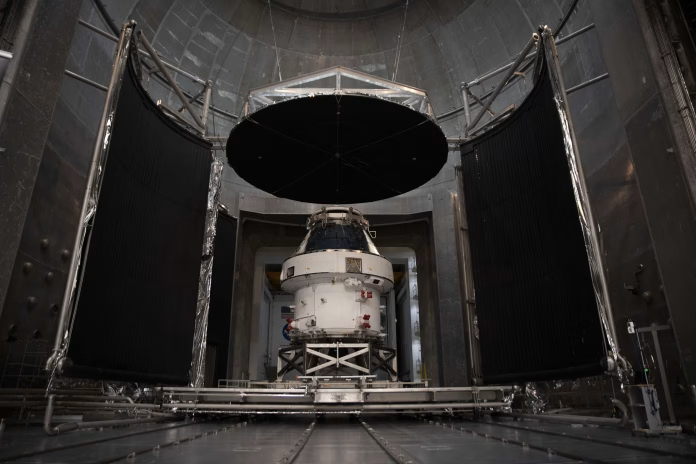
Among the most pressing problems in the race to be the first to establish a permanent human settlement off the Earth is the availability of a sustainable source of power in locations where access to the sun is either impossible or intermittent. It was announced by NASA and the United States Department of Energy to build a nuclear fission reactor on the Moon by the year 2030.
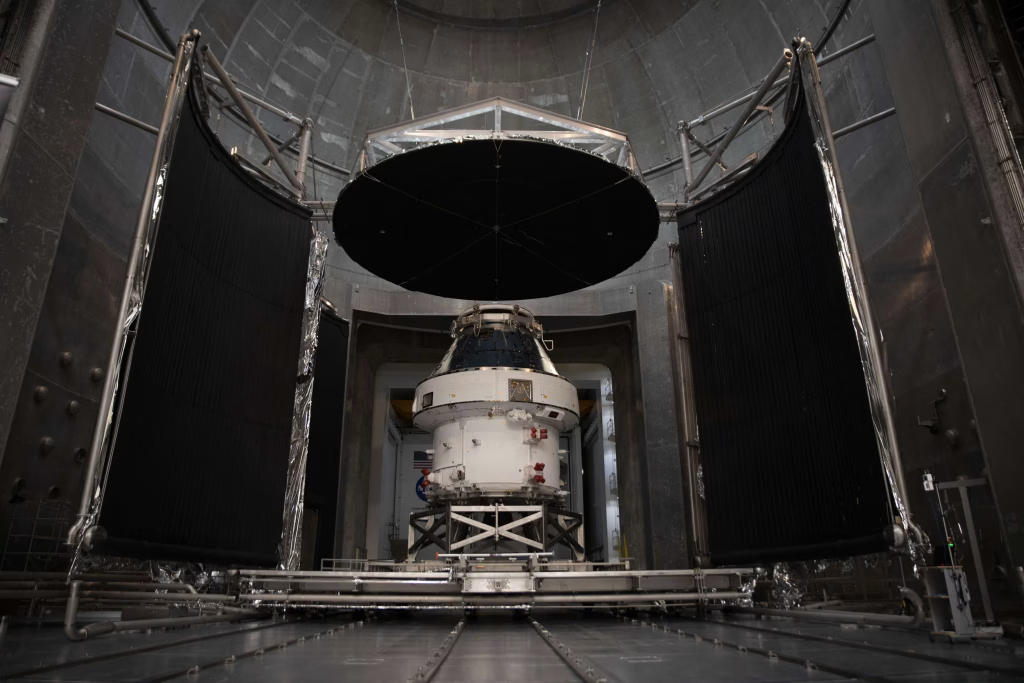
It is the outcome of R&D work carried out in nuclear space, ranging from radio-isotope power stations to nuclear reactors in the last few years. Unlike solar panels, which cannot work when the Moon enters its night phase for two successive fortnights, a fission surface power station will work in all conditions. This is part of the Artemis Mission to Mars by NASA.
The reactor that will power this endeavor will have the capability of producing at least 40 kilowatts of power, sufficient for 30 families for a period of at least ten years before refueling. This particular reactor will have the capability of facilitating self-containment missions, habitat and rover power and science instruments, and possibly In-Situ Resource Utilization plants for the production of water, fuel, and other resources. This particular reactor will surely make possible missions of unimaginable scale.
The reactor to be constructed on the Moon would face some challenging designs. The presence of an atmosphere inside the Moon reactor would create problems related to the dissipation of heat. The reactor would have to be designed to dissipate heat efficiently, as it would not have a cooling tower. The electrostatically charged, very abrasive lunar dust would create a challenging environment. Radiation shielding would also be necessary to shield the astronauts working close to the reactor.
NASA’s fission surface power project has been designed on the basis of the Kilopower project, where the feasibility of small uranium-powered reactors named KRUSTY was tested in 2018. This project has already validated that heat pipe/Stirling engine technology is applicable for power production for space exploration. This technology can be applied for enhancing the efficiency of the system so that it can be easily operated on the surface of the Moon.
Industry collaborations are required to be done to achieve this. In 2022, NASA and DOE competitively awarded design contracts to three companies in the US – Lockheed Martin, Westinghouse, and IX. These three companies had to develop a design for a reactor that would be flight-capable. It must be possible to encapsulate it in a six-meter-long and four-meter-diameter launch package. Its mass must not be more than 6,000 kg. They are required to develop a reactor that can be utilized even when it is deployed from a lunar lander or any other location.
However, its uses do not end when it comes to the Moon. Its uses can be applied to Mars surface missions too. There may be a lot of dust present in its atmosphere or may not be much sunlight available to allow it to harness solar cells to generate power. This may open many avenues for innovations to be developed in nuclear propulsion systems to allow faster means to reach other space destinations. Fission technology may enable a wide range of applications that cannot be done today.
For NASA and the DOE, the lunar reactor is much more than a mission-enabling tool it is the enabler of a strategy to permanently establish a human presence in space. This will go down in history as one of the greatest achievements of nuclear energy and space travel and will mark the beginning of a new era where energy will no longer be the limiting factor for human expansion into the solar system.


