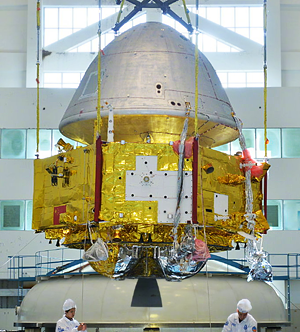
Above is an image that represents the first time an interstellar object has been captured in an image from the orbit of another planet. That distinction goes to the Chinese Tianwen-1 Mars orbiter, which succeeded in capturing high-resolution views of comet 3I/ATLAS during its passage near Mars in October of 2025, using its High Resolution Imaging Camera. The geometry mattered: the target was not a well-lit landscape a few hundred kilometres below but a faint, fast-moving smear of reflected sunlight tens of millions of kilometres away crossing a dense stellar background. In engineering terms, the achievement was less about raw optics than about pointing control, timing and data handling under constraints that the spacecraft never was originally built to face.

3I/ATLAS is not another comet with a convenient flyby. It is only the third confirmed interstellar object-after 1I/’Oumuamua and 2I/Borisov-its hyperbolic trajectory being the signature that it is passing through rather than orbiting the Sun. Published estimates bracket the nucleus diameter up to 5.6 km, while the incoming speed is widely cited at 58 km/s a pace which turns small navigation and exposure decisions into make-or-break variables for imaging systems. Observations from the Martian vantage point were taken at about 30 million km a distance which forces spacecraft cameras designed for planetary mapping into a regime closer to astronomical tracking.
The images from Tianwen-1 matter because they marry a rare subject with an unusual observing platform. Cameras such as HiRIC are tuned for contrast-rich terrain, stable illumination, and predictable motion relative to the spacecraft’s ground track. In order to track a dim comet, it requires a very different posture: extremely short exposures to suppress motion blur, repeated frames to build signal, careful calibration lest the target get lost amid background stars. According to China’s space agency, Data acquired by a high-resolution camera was received, processed and displayed by a ground-based application system a good reminder that “the image” is often the final product of spacecraft pointing plus extensive ground reconstruction, not a single shutter click.
HiRIC’s success also reframed what “mission extension” can look like for modern deep space spacecraft. Tianwen-1 entered Mars orbit in 2021 and was built to map and characterize Mars, supporting a lander and the Zhurong rover. Repurposing an orbiter camera for interstellar comet work is not a simple task swap but rather a systems-level trade among attitude control margins, onboard storage, downlink scheduling, and the operational risk of commanding large slews away from routine observation geometries. The reward is a dataset which inherently is hard to obtain from Earth when the comet’s sky position, solar elongation, or seasonal weather becomes limiting, and that can complement what other spacecraft see from different angles.
Those complementary angles became the defining feature of the broader observing campaign. ESA’s Mars orbiters tried the same basic feat-pushing cameras meant for bright surface imaging into deep-space tracking. ESA quantified the contrast problem rather bluntly, CaSSIS principal investigator Nick Thomas saying, “The comet is around 10 000 to 100 000 times fainter than our usual target.” That one ratio explains why these observations are operationally expensive: long enough exposures to see the comet can saturate star fields, while short exposures that keep stars tame can erase the comet entirely.
NASA’s fleet of Mars orbiters offered a different kind of leverage. The Mars Reconnaissance Orbiter deployed its HiRISE camera, another surface specialist, to get a view at a scale of about 30 km per pixel, and NASA emphasized how such rare targets reliably produce new science. “Observations of interstellar objects are still rare enough that we learn something new on every occasion,” said Shane Byrne, HiRISE principal investigator at the University of Arizona in Tucson. “We’re fortunate that 3I/ATLAS passed this close to Mars.” MAVEN, built to study Mars’ upper atmosphere, pointed its ultraviolet spectrograph toward the comet to probe hydrogen and related species, a pathway to understanding how much water vapor is being released as sunlight warms the coma.
From Tianwen-1’s perspective, the images clearly separated the comet’s architecture into a compact core and surrounding haze. China’s statement caught that basic morphology in plain words: “The images clearly show the comet’s distinctive features, consisting of a nucleus and a surrounding coma, with a diameter reaching several thousand kilometers.” In the main release the tail was described as extending roughly 56,000 km, with the coma spanning thousands of kilometer-dimensions which are large in absolute terms but still faint when diluted across 30 million kilometers of space.
What those structures contain is the deeper prize. Early discussions of 3I/ATLAS have focused on volatiles such as water ice and carbon dioxide, with weaker signals consistent with carbon monoxide, and on the comet’s reddish appearance – often linked to dust enriched in organic compounds. Those chemical hints are valuable partly because interstellar objects are not “samples” of a single place; they are products of long exposure to radiation and cold storage between stars, and then a brief, intense heating episode as they plunge through a new system. For instrument teams, that means the target can evolve quickly: jets can strengthen, grain sizes can change, and spectral signatures can turn on and off depending on heliocentric distance and the thermal history of the nearsurface layers.
The campaign also drove home a more pragmatic reality of space science in the 2020s: flagship returns are increasingly to be had by re-tasking extant assets, rather than sending bespoke ones. Cameras and spectrometers already in orbit around Mars can be pointed skyward, often with little more than software and operational changes, to catch a once-indecades visitor. That flexibility becomes a design virtue in itself – an argument for spacecraft which can safely slew, track and calibrate beyond their primary objectives, and for ground systems able to process unusual sequences without months of tool rebuilding.
For China, the payoff runs well beyond one set of images. CNSA framed the comet work as a technical rehearsal for small-body exploration and for the next Tianwen missions, including Tianwen-2 aimed at sampling the near-Earth asteroid 2016HO3 and later visiting main-belt comet 311P. In that sense, 3I/ATLAS was a moving calibration target for deep space operations-a test of how fast a mission team can respond to new ephemerides, how accurately a spacecraft can point at a dim object, and how reliably the data pipeline can turn marginal photons into publishable science.
Of course, interstellar comets do not hang around, and 3I/ATLAS will continue on outwards, carrying its secrets with it. The lasting value of Tianwen-1’s images is that they extend the observational playbook: interstellar objects may be studied not just from Earth orbit and from ground-based telescopes but from planetary orbit as well-where the standpoint, the lighting, and the instrument constraints push engineers and scientists to extract meaning from the edge of what their hardware was designed to do.