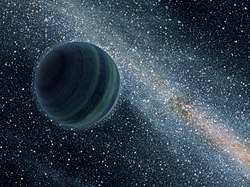
However, what constitutes a planet in particular is a question that may seem very simple but has been escalating in complexity as scientists discover new planets that defy the classical definition. This is when The International Astronomical Union’s definition in 2006-that a planet must revolve around the Sun, and that it has enough mass to be rounded by its own gravity-took care of all those issues within our own Solar System and created a whole new breed of planets that are left in limbo-rogue planets.

The rogue planets are free-floating, spanning across the galaxy without being orbited by any star, just drifting on their own. There are two ways of how they came into existence. Some of them develop within a stellar system, condensing from a protoplanetary disk like Earth and Jupiter, but they end up being gravitationally kicked out of it. Others form from an interstellar cloud of gases, which happens in exactly the same way that stars form, but they stop before any fusion of hydrogen takes place. It shares some similarities regarding definitions with brown dwarves, planetary masses measuring between 13Jupiter to 93 Jupiters. They can deuterium fuse temporarily. As explained by astrophysicist Jayawardhana, “Our observations confirm that nature produces planetary mass objects in at least two different ways from the contraction of a cloud of gas and dust, the way stars form, and in disks of gas and dust around young stars.”
The detection of such evasive objects requires an approach different from what is used in exoplanet detection, where a star’s light source is employed. Infrared observations have shown significance, as young rogue planets would be radiating from the stored heat of planet formation. The James Webb Space Telescope was used to detect six rogue planets in NGC 1333, with masses ranging from five to ten times Jupiter’s mass. One of these rogue planets has a dusty disk, presumed to be in the process of creating moons. This is in addition to silicate grains being found in an accretlement disk around a rogue planet, an indicator of possible planetary bodies within a mini planetary system, developed around a rogue planet and separate from any star system.
Another method that has proved to be extremely effective is that of gravitational microlensing. First predicted in Einstein’s General Theory of Relativity, microlensing results in the bending of light around a massive object that is passing in front of a distant star. This phenomenon can also help identify rogue planets that transit in front of a dense field of stars, producing a brief flash of brighter intensity that may last only a matter of hours for an Earth-weight planet. CCD mosaic cameras with high cadence have improved this method in OGLE, MOA, or KMTNet surveys that have identified rogue planet candidates with sizes down to Earth. In a rare occasion, OGLE-2016-BLG-1928 showed a luminosity fluctuation of 20% in six hours, typical of an Earth-sized rogue planet.
Infrared detection of sensitivity by JWST has been used to find planetary mass rogues and to set limits on their formation mechanisms. For instance, there were no objects below five Jupiter masses in NGC 1333, although this could have been detected by the telescope, setting a lower mass limit on direct cloud collapse. Supporting infrared studies by ground-based telescopes, including ESO’s VLT X-shooter, observedchaotic accretion outbursts on rogue planets such as Cha 1107-7626, which was observed to accrete six billion kilograms of matter per second in August 2025, changing disk chemistry by including water vapor and hydrocarbons and demonstrating inflows along magnetic fields first-ever observed in a star.
The demographics of rogue planets will be completely redefined by the soon-to-come Nancy Grace Roman Space Telescope. With the aid of its 2.4-meter mirror, broad-field infrared sensors, and constant observation of the bulge in the Milky Way galaxy, Roman will be able to identify hundreds of rogue planets down to Mars’ mass. The rogue planets’ microlensing data acquisition mission aims at least ten times more accuracy in determining the actual numbers of rogue planets, refining the “free-floating mass function” and distinguishing between ejected planets and star-like formations. As co-author Matthew Penny notes, “Roman is a game-changer for rogue planet searches.”
These conclusions call into question the long-held belief that planets always come together with their corresponding star companions. In the words of Dr. Belinda Damian, “The building blocks for forming planets can be found even around objects that are barely larger than Jupiter and drifting alone in space.” For someone such as myself, an aficionado in the area of the space sciences, the list of rogue planets represents something far more profound-it represents the redefinition of the boundaries themselves that circumscribe planets.