“Confirming a non-universal X-ray-to-ultraviolet relation with cosmic time is quite surprising and challenges our understanding of how supermassive black holes grow and radiate,” says Dr. Antonis Georgakakis, in a finding set to turn astrophysical consensus on its head. It is a relationship so stable that it has long served as a standard candle for the measurement of the expansion of the cosmos. Today, the times seem to be racing for the evolution of the ruler.

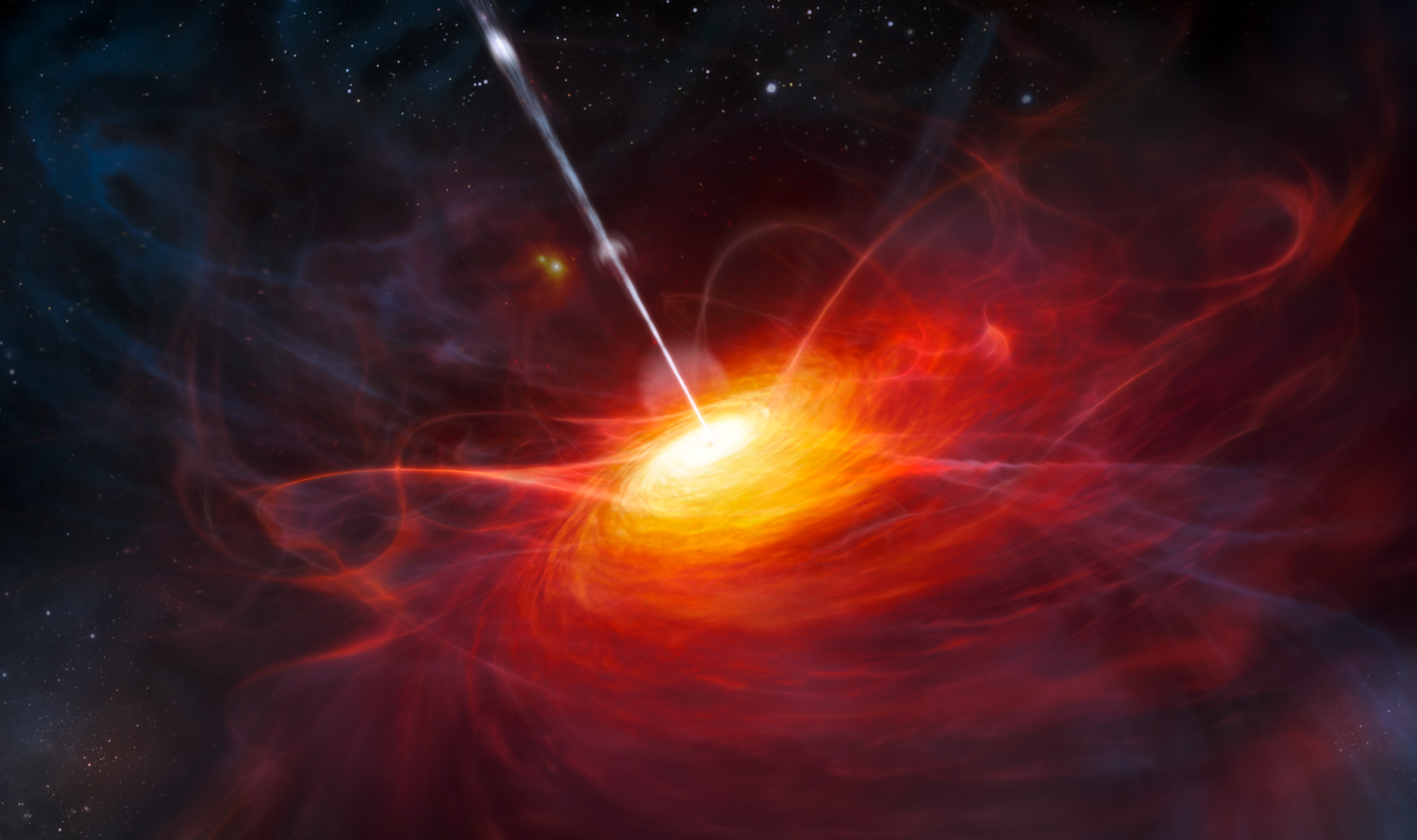
Quasars, bright distant lighthouses consisting of supermassive black holes, emit across all wavelengths of the electromagnetic spectrum. The accretion disk, formed by accreting material toward the black hole, heats up to hot ionizedGas emitting large amounts of UV radiation. Above this disk is the corona, a reservoir of hot, energetic plasma, where the upscattering of UV photons occurs into X-rays. Much work has been done based on this disk-corona paradigm, where models correlating the amplitude of theUVemission are defined by physical variables like temperature, plasma density, and rates of magnetic reconnections. The observation of quasars in nearby clusters has been consistent over the years based on a constant ratio ofU-to-X-rayemissions, which has been utilized for use as “standard candles” in determining other large-scale properties of the universe.
The present research made the best of the complementary strengths of the two X-ray space-based observatories: the eROSITA instrument, aboard the Spektr-RG, and the ESA’s XMM-Newton satellite. The wide-angle survey of objects, performed by the eROSITA, had led to an unprecedented map of the distribution of quasars on the sky, but the shallow exposures always led to a mere handful of X-ray photons per object being detected on average. To pull out significant patterns from this data set, with so few measurements, the observers resorted to the techniques of Bayesian statistical analysis, highly efficient in identifying hidden patterns superposed upon random fluctuations of data.
By merging the broad coverage of the data from the eROSITA with the deep, existing data from the XMM-Newton, the observers managed to reconstruct the coverage of the dataset from the modern-era universe back to the light from the universe’s birth, some 6.5 billion years.
This, in fact, is a systematic trend, as the UV-to-X-ray correlation looks differently for high-redshift quasars than for low-redshift ones. This immediately implies that the energy coupling between the disk and corona can, in some way, change with cosmic time, depending on the evolution of the average accretion rate, spin distributions, or the corona structure. There are also models where the more dense or magnetically active corona in the early Universe affects the efficiency of the X-ray production.
From the perspective of cosmology, this result is of great significance. The relation of UV to X-rays is essential for quasar distance measurements, which are further supported by supernovae and baryon acoustic oscillations in terms of constraining dark energy. If this relation is varying at high redshifts, then the values of the Hubble constant and equation of state for dark energy parameter w might need to be revised. The cosmological implications extend even into the physics of quasars.
Most high-redshift quasars from a group of surveys including Pan-STARRS, the DESI Legacy Survey, and SkyMapper are typically known to harbor supermassive black holes with masses above \\( 10^9 M_\\odot \\) with strong blueshifts of C IV of 5000 km/s or larger, up to 47,000 km/s. Models of these processes might play a role in determining the coronae, especially if a strong outflow is occurring around the inner accretion disk. It is likely that radio-loud quasars with jets that dominate the high-energy emission have a differing UV/X-ray scaling. This finding heavily relied on its instrumental capability.
eROSITA has sensitivity to soft X-rays in the 0.5-2keV bandwidth with a sensitivity 20 times greater than that of ROSAT and has 15-30 arcseconds angular resolutions and 0.8 degrees² field-of-view. Deeper exposures and higher spectral resolution are possible through XMM-Newton observations. Moreover, precise flux estimates are possible even with faint sources. This study has statistically combined shallow and wide-field quasar observations with deep targeted data.
This will be improved on with the forthcoming missions. The forthcoming all-sky scans with eROSITA will increase the quasar sample. Next generation missions with higher resolutions and sensitivity are being pursued with projects like Athena. Simultaneously, multinational projects ranging from the infrared capabilities of the James Webb Space Telescope to ground-based 30-40 m class optical telescopes will pin-point properties concerning accretion discs and coronae.
Within the context of Bayesian models, these data will unveil which one of the properties whether UV-X-ray shift being a quasar innate property or a form of bias the observational universe holds. However, the message gets through clearly: the cosmic lighthouses that we think we understand are actually changing their beams through time, and the cosmic measuring tools, the instruments that measure the expansion of the universe, need to overhaul themselves to accommodate themselves to the evolving light signals.