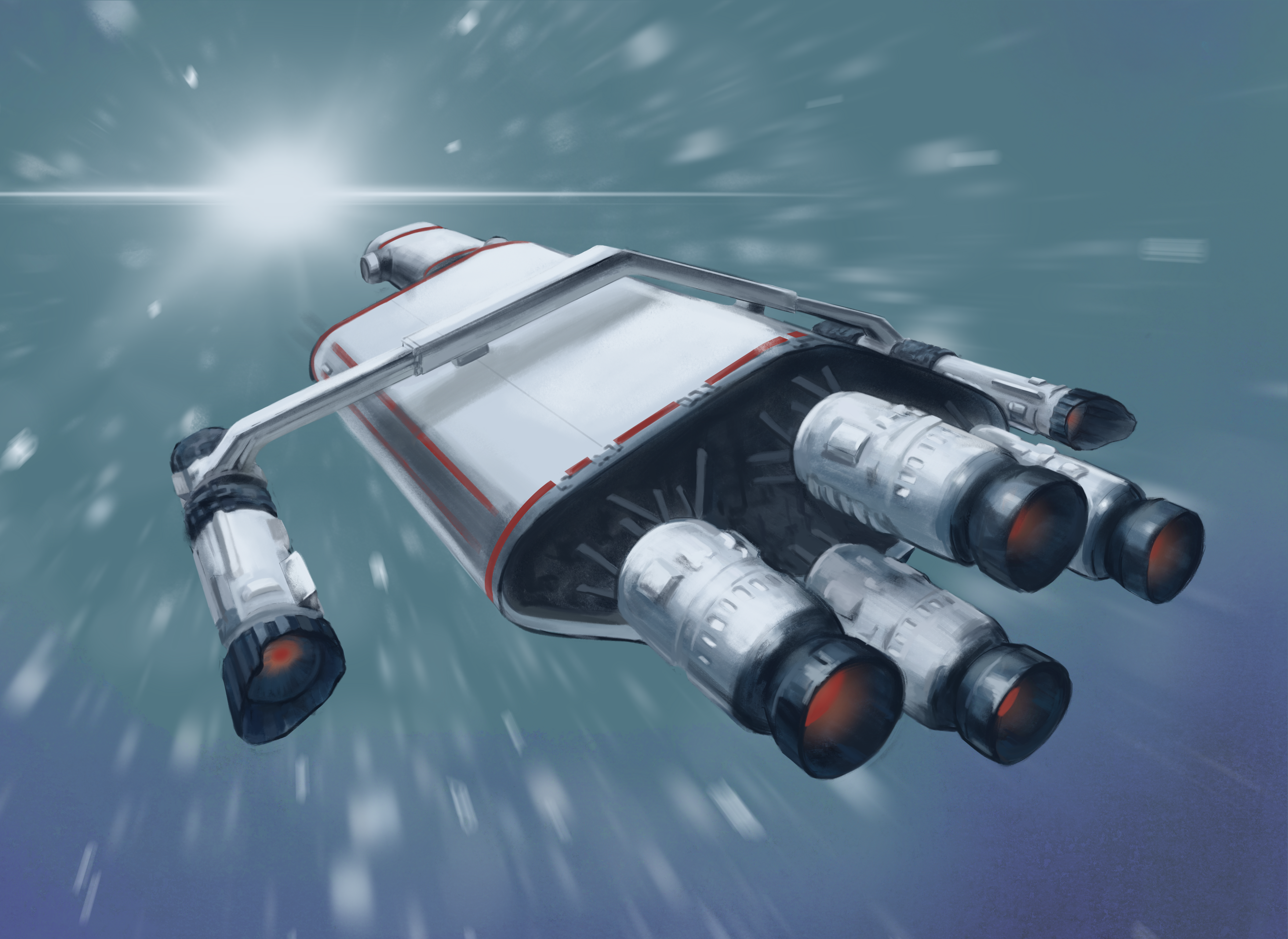
Negative energy may not be the showstopper it might be the geometry. That’s the bottom line from the latest warp‑drive study by Harold “Sonny” White, which trades the iconic smooth warp ring of Miguel Alcubierre’s 1994 concept for a set of discrete cylindrical “nacelles.” The shift is more than cosmetic. It reflects a deliberate engineering turn in spacetime metric design, aimed at reducing hazardous gradients, distributing stresses and producing a bubble interior that is as calm and clock‑synchronized as any spacecraft cabin in Newtonian space.

This originally hypothesized warp metric, proposed by Alcubierre and derived from Einstein’s general theory of relativity, consisted of a toroidal band of exotic matter around the vessel. It would have acted to contract spacetime in front of the craft while expanding it behind. Such a bubble could then travel at speed greater than light from the point of view of distant observers, even though the ship in the interior of the bubble is actually in local standstill. But here again was the problem: such curvature required negative energy densities on the order of cosmic mass scales and steep curvature gradients which could create destructive tidal forces at the bubble wall and particle cascades.
White’s new configuration, segments that ring into multiple cylindrical warp nacelles, was developed at Casimir and published in Classical and Quantum Gravity on December 8, 2025. Each warp nacelle provides a spatially localized channel for exotic energy, patterning curvature only in the neighborhood of that particular nacelle. Between these, there exists a structurally “flat” interior region: that is, an ADM 3+1‑formulated spacetime slice in which the lapse function, shift vector, and spatial metric can be set independently from one another. In such a formalism, the lapse dictates the rate of onboard clocks, while the shift dictates spatial flow around the hull and the spatial metric dictates the distribution of curvature. Under this design, strong curvature is confined to nacelle zones, thereby mitigating tidal forces and avoiding large‑scale gradients sweeping through the habitable volume.
The ADM 3+1 decomposition is a standard tool of numerical relativity, but it also supplies the engineer with a means to regard spacetime as a dynamical system, complete with state variables and evolution laws. That is to say, in the context of warp drive, curvature profiles can be “dialed in” much like thrust vectoring in rocketry-desirable, but subject to the constraints of the Einstein field equations. White’s team compared the classical Alcubierre spherical bubble to their interior-flat cylindrical-nacelle topology and found that segmentation does indeed allow for smoother curvature transitions at the bubble boundary, thus potentially lowering the risk of high-energy particle production.
This change in geometry also represents a larger trend in warp research, which treats bubble shape, wall thickness, and layering as optimization parameters, rather than fixed givens. Earlier work by White on toroidal shaping and oscillating field intensities showed that the energy requirements could be reduced by many orders of magnitude in idealized models. The nacelle approach extends this by making the curvature sources modular. In principle, the number, length, and diameter of nacelles might be tuned for mission profile, stability margin, or manufacturability, much as aerospace engineers select engine counts and placements.
While this model still relies on exotic matter, the work draws lessons from positive‑energy warp ideas. It has been shown by Lentz, Fell, and Heisenberg that solitonic geometries can, in principle, yield warp‑like transport without violating classical energy conditions at very large energy scales. Similarly, the classification of subluminal warp drives by Bobrick and Martire demonstrates that one can, in principle, engineer physically allowed stress–energy distributions for more gradual, below‑light‑speed transport. Together with White’s segmentation of nacelles, this might be combined in the future with such positive‑energy or subluminal regimes to give a stepping‑stone toward practical demonstrations of these phenomena.
From an engineering standpoint, there are several good reasons to distribute curvature sources onto nacelles: doing so will naturally create “hard points” for structural integration and thermal management/field-control hardware; there is also opportunity for phased or asymmetric activation related to steering or dynamic shaping of the bubble‑in‑response to external conditions. It reflects the modularity of a real space craft which also integrates multiple propulsion units, for redundancy and for maneuvering.
And perhaps even more important, interior-flat is no mere comfort feature but rather is actually the only way to keep onboard clocks in synchrony with mission control, to negate inertial forces, and to reduce structural loads. These were already idealized properties of Alcubierre’s original metric, but achieving these combined with reduced tidal gradients and a more engineerable energy distribution definitely creates a refinement worthy of recognition. White emphasizes, however, that this remains a theoretical construct within classical general relativity and not a laboratory prototype.
“Warp drive physics is still in its infancy,” he points out, and the path from metric to machine will have to be lined with breakthroughs in materials, field generation, and energy sourcing. But by recasting the problem-one of geometry and control, rather than of unattainably large energy densities-this work puts warp‑drive research on the same footing as the iterative, parameter‑tuning mindset that has brought other once‑impossible technologies to maturity.
For the space enthusiast with a scientific bent of mind, the nacelle-based warp bubble is a reminder that the bridge between science fiction and engineering reality is built in increments: new metrics, new formalisms, new ways to think about shaping spacetime itself. Each refinement, like this segmentation, is a small but tangible step toward a future where “warp‑capable configuration” is more than a line in a starship’s spec sheet.