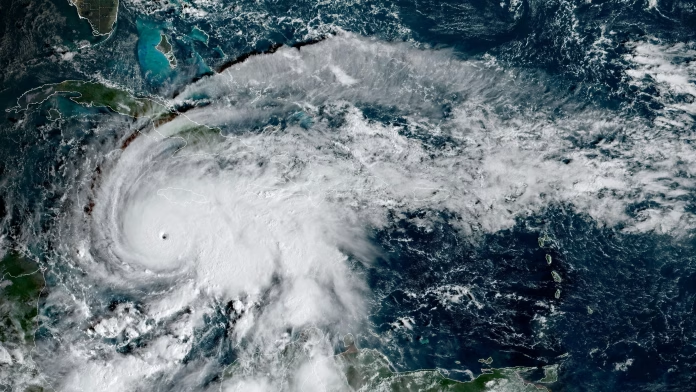
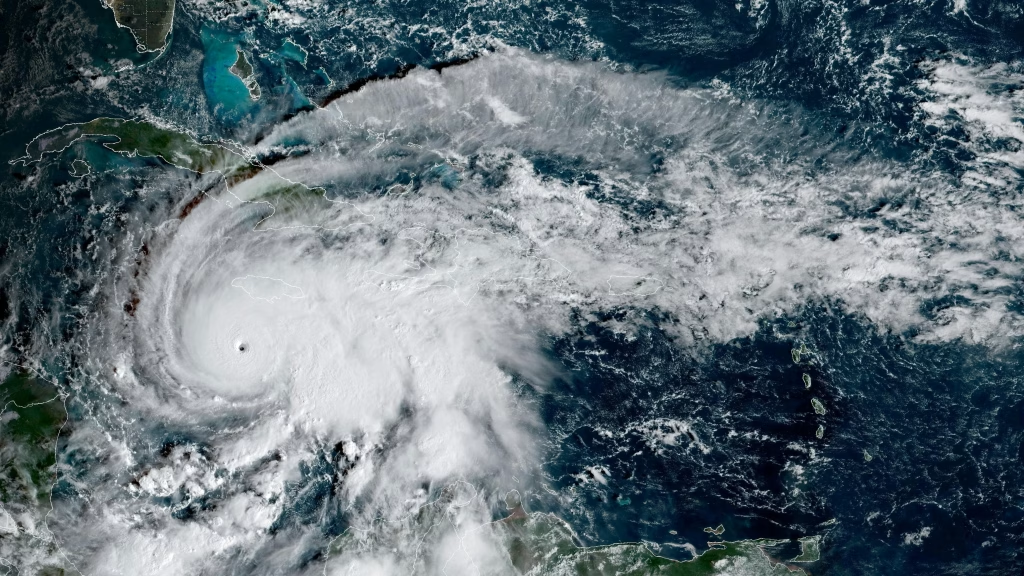
Can artificial intelligence finally crack one of hurricane forecasting’s most stubborn challenges-predicting rapid intensification with precision and speed? During the 2025 Atlantic hurricane season, the National Hurricane Center integrated Google DeepMind’s latest AI weather model into its operational toolkit. The results were striking: In the case of Hurricane Melissa, one of the strongest Atlantic storms on record, the AI provided forecasters with an unusually high degree of confidence that the storm would escalate from a Category 1 to a catastrophic Category 5 in just a few days. This early certainty allowed warnings to be issued well ahead of Jamaica’s encounter with 185 mph winds-a rare forecasting success in a domain where intensity predictions often lag track accuracy.
Traditional NWP models, such as the European Centre for Medium-Range Weather Forecasts system and NOAA’s Global Forecast System, are based on solving sophisticated fluid dynamics and thermodynamic equations over a global grid. Such simulations require substantial supercomputing resources and several hours of execution time. They also include the process of data assimilation-merging satellite, radar, and in-situ observations into a coherent atmospheric state-a highly computationally intensive but vital process for improving their accuracy.
DeepMind’s AI model bypasses much of this computational load. Trained on more than four decades of six-hour-interval historical weather data, it learns to recognize subtle atmospheric patterns leading up to particular storm behaviors. Once the model is initialized-often with current conditions derived from physics-based analyses-it can output hundreds of ensemble scenarios in minutes. This approach to ensembling, in concept similar to the multiple-run NWP ensembles of today, quantifies forecast uncertainty by varying initial conditions slightly and observing how outcomes diverge.
The underlying architecture is based on advances such as GraphCast’s graph-transformer mesh, which enables the model to process efficiently global weather fields. Instead of computing the next atmospheric state directly from physical laws, AI predicts residual changes relative to the current state, using learned statistical relationships. This allows rapid, high-resolution forecasts without the bottleneck of solving full-scale differential equations.
Melissa’s forecast showcased the AI’s strength in rapid intensification scenarios-a process increasingly common in a warming climate, where storms can gain 35+ mph in wind speed within 24 hours. Such events are notoriously difficult for physics-based models, as they depend on small-scale processes like eyewall replacement cycles and anomalies in ocean heat content that are tough to resolve at global model resolutions. By leveraging historical analogs, the AI captured Melissa’s explosive growth more convincingly than most traditional models.
But experts urge caution against over-reliance. AI models do best when an event lies within the range of its training data. As researchers from the University of Chicago showed, removing the most violent storms from training sets results in the systematic underestimation of extremes. In their experiment, an AI trained without Category 5 hurricanes consistently downgraded such scenarios to Category 2 intensity. This tends to emphasize a key reason why physics-based models are not about to become obsolete: they can model unprecedented atmospheric states by applying the basic laws-even when no historical analog exists.
Forecasters like Ryan Torn emphasize that in AI, the tendency to “smooth out” sharp gradients in order to reduce error can be physically misleading. Physics-based models retain these gradients because of their base on conservation laws and dynamic equations; they make sure features such as sharp pressure drops or temperature contrasts are correctly represented. The most promising path forward lies in hybrid modeling. AI can ingest outputs from physics-based models as part of its training, combining the latter’s physical fidelity with the former’s speed and pattern-recognition prowess. This synergy could extend beyond wind and track forecasts into domains such as flood prediction, where high-resolution, street-level forecasts are critical but computationally expensive.
AI’s ability to emulate such detail rapidly, when trained on physics-based outputs, offers a glimpse of next-generation hazard modeling. For the moment, Melissa serves as a case study for the operational potential of AI. It proved that machine learning can equal and in some instances even outperform the best available physics-based guidance in track and intensity, issuing actionable forecasts more quickly and with less computational overhead. But with climate change now sending storms into uncharted territory, it’s the union of AI’s speed with physics’ universality that will be necessary to keep pace with the atmosphere’s evolving extremes.


