
The question isn’t if a $3,000 tri-fold should be durable, it’s how far Samsung is willing to go in proving it. The Galaxy Z TriFold, due early 2026, is its most complex foldable yet, with a production line more akin to a high-precision robotics lab than a smartphone factory. Assembly begins with the incorporation of two differently sized Armor FlexHinges, designed for different stress points of the dual fold mechanism.
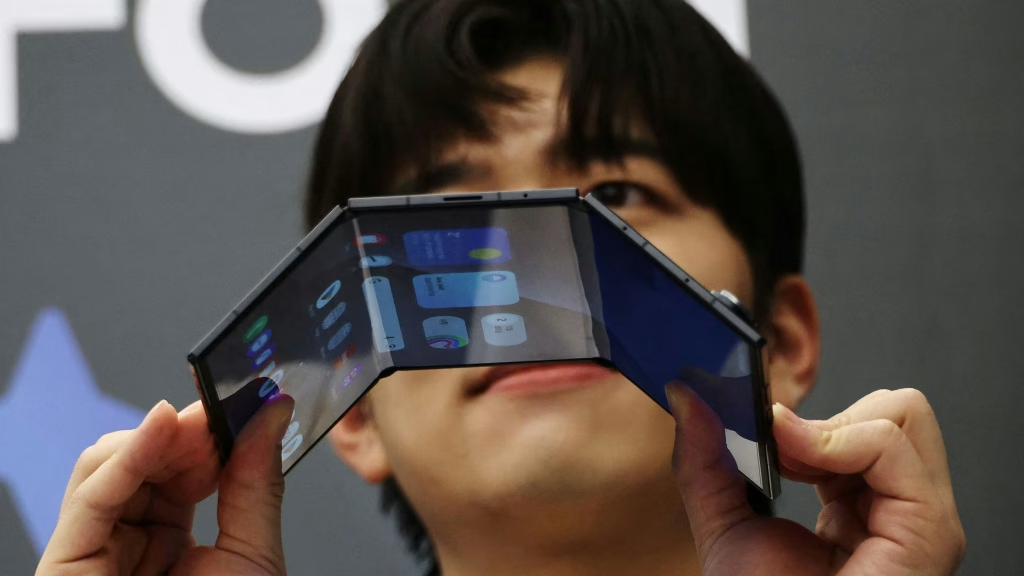
The hinges aren’t larger versions of current hinges but boast a dual-rail structure and titanium housing for super-smooth folding that resists wear over time. Next, automated systems bond the flexible OLED display to its shock-absorbing layer, then apply a timed pressing process for a thinner yet stronger panel. The frame consists of Advanced Armor Aluminum, an ultra-high-strength alloy that provides rigidity without bulk. The back has ceramic-glass fiber-reinforced polymer to keep the device light and resistant to cracks.
Before one unit leaves the line, Samsung puts it through an exhaustive durability gauntlet. A 3D laser scanning process inspects the 10-inch display for surface uniformity in an effort to eradicate creases and imperfections that have plagued foldables since their inception. High-speed CT imaging-normally a feature of medical diagnostics-analyzes the flexible printed circuit board for precise internal alignment before final assembly.
Then there is the folding torture test: 200,000 open-close cycles, which is the equivalent of 100 folds a day over five years. That is far more aggressive than most consumer electronics testing and a direct response to the lessons learned from earlier foldables and independent experiments that exposed their mechanical failures well before their supposedly touted lifespans. In the case of the TriFold, the hinge and display materials have to be designed to keep up with the structural integrity with minimal creasing over the lifetime of the device.
Samsung uses reinforced Ultra Thin Glass with a much thicker protective overcoat, leveraging advances in materials science found in bulletproof composites by balancing flexibility against impact resistance. And then there’s water resistance. The TriFold has an IP48 rating, meaning it should tolerate dust particles over 1mm in diameter and submersion in freshwater down to 1.5 meters for up to 30 minutes. That requires some serious sealing on and around the hinge components: both dust-deflecting bristles and gasket systems to maintain ingress protection without compromising folding smoothness.
Like most foldables, Samsung advises against exposure to either salt or chlorinated water – over time, it will erode the seals. The real-world scenario test pushes the device through a mix of network conditions, temperature extremes, and different battery load profiles to simulate the unpredictable environments of daily use. That includes stress on the Snapdragon 8 Elite Mobile Platform, the 200MP camera array, and the 5,600 mAh three-cell battery found across the TriFold’s panels for balanced weight and power delivery. The battery system supports 45W fast charging to make sure that even under heavy multitasking-like running Samsung DeX8 across multiple workspaces-the device will keep up all day long.
Most importantly, Samsung’s attention to hinge engineering is especially critical for a tri-fold form factor. This is because the dual hinge system must evenly distribute torque across two pivot points to prevent asymmetric wear that would cause misalignment or stress fractures in the panel. Minimizing the gap between folded panels allows the TriFold to achieve a slimmer profile without risking display contact damage-a feat made possible by precision-machined hinge components and tight manufacturing tolerances verified with laser metrology.
For the early adopters, the TriFold’s durability story is as much about confidence as it is about engineering spectacle. Every CT scan, every laser pass, and every folding cycle acts as a fail-safe against the mechanical and cosmetic failures that have haunted devices with folding displays. In revealing these processes, Samsung is doing more than just marketing a phone-it’s making the case that the tri-fold category has matured into a daily driver, one built to survive years of demanding usage without losing that premium feel.


