
“Launch capacity is now a defining factor in the U.S.’s ability to compete and lead in the space economy,” said Stoke Space investor Thomas Tull earlier this year. For Sam Altman, that capacity may also become the next battlefield in his decade‑long rivalry with Elon Musk.
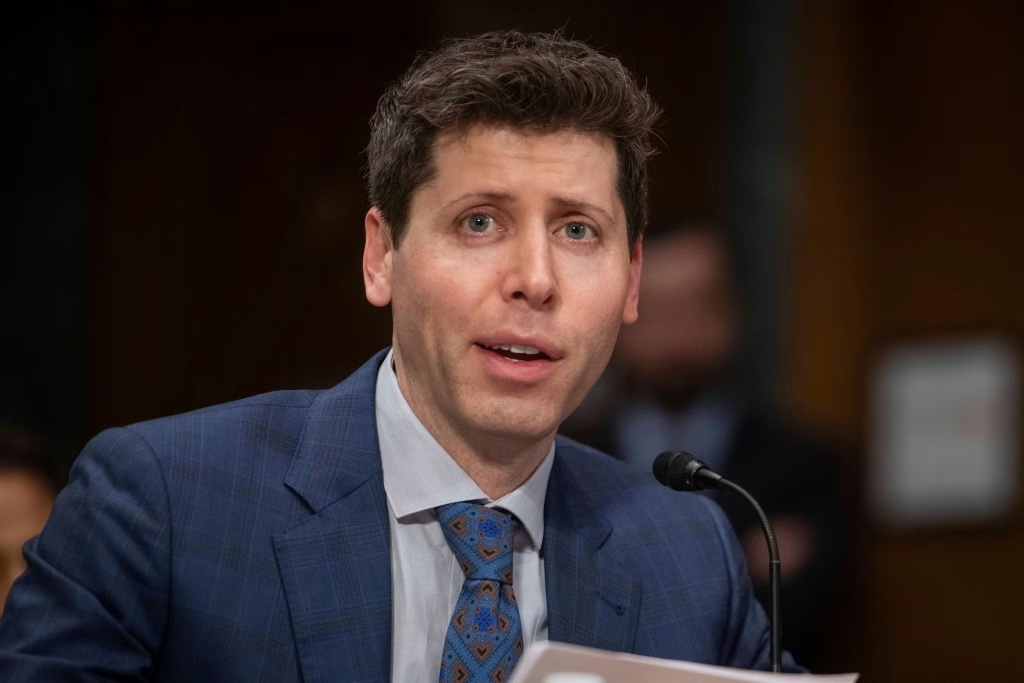
According to reports, Altman discussed a possible partnership or full-on purchase of Stoke Space Technologies, a Kent, Washington‑based startup formed by former Blue Origin engineers. Stoke is creating Nova, a fully reusable medium‑lift rocket designed to send payloads between two and twenty tons into orbit. Unlike SpaceX’s Falcon 9, which only reuses its first stage, Nova’s engineering is for complete stage recovery. Its liquid‑cooled heat shield is a key innovation, enabling second‑stage reusability and enabling dramatic reductions in launch costs. Launching off Cape Canaveral’s historic Launch Complex 14 is on Stoke’s road map; first flights are targeted for next year.
Altman’s interest in Stoke aligns well with his public advocacy for off‑world computing infrastructure. Already, there are over 5,000 data centers running in the U.S. and their projected electricity demand is enormous-Goldman Sachs predicted 165% increase by 2030. Altman has floated several ideas, including everything from orbital solar‑powered facilities through to Dyson‑sphere‑scale energy harvesting. With a rocket company, he would have the logistical backbone to launch such space-based data centers into orbit, out of reach for both terrestrial grid limitations and environmental constraints.
Those talks with Stoke reportedly began last summer and heated up in the fall, with proposals for multibillion‑dollar equity investments that could have given OpenAI a controlling stake. Altman’s history with the company stretches back to his tenure at Y Combinator, which invested in Stoke early on. But those discussions have gone dormant at least for now after Altman declared a company‑wide “code red” to counter Google’s surging Gemini 3 model. That directive shifted OpenAI’s resources toward improving ChatGPT, delaying other ventures, including any aerospace ambitions.
The potential move into rocketry would mark yet another direct collision with Musk, whose SpaceX dominates the commercial launch market and is pursuing similar goals for fully reusable rockets with Starship. The two men’s feud is rooted in OpenAI’s founding in 2015 when they served as co-chairs of a nonprofit dedicated to “advance digital intelligence… unconstrained by a need to generate financial return”. Musk left in 2018 after failed attempts to merge OpenAI with Tesla or secure majority control, later accusing the company of becoming a “closed-source de facto subsidiary” of Microsoft.
That rivalry has since spilled into everything from business to technology: Musk introduced xAI and its Grok chatbot to rival ChatGPT; Altman invested in a brain-computer interface startup to rival Neuralink and began developing a social media network to rival X. The bad blood spilled into lawsuits, political arenas, and public insults: Musk labeling Altman “Scam Altman”; Altman ridiculing Musk’s offers with jokes about buying Twitter for a fraction of the price he paid for the company.
From an engineering perspective, Stoke’s Nova offers Altman a shortcut into the launch market, bypassing the decade‑long learning curve that SpaceX had to endure. The startup’s nearly $1 billion in funding from investors including Breakthrough Energy Ventures and Toyota Ventures underlines confidence in its engineering approach. And its inclusion on a U.S. Space Force list of national security launch providers before reaching orbit suggests strategic relevance. To Musk, any Altman‑backed competitor in orbital launch services is more than symbolic; it’s a threat to SpaceX’s dominance in a sector where reusability and launch cadence are two of the most crucial competitive moats.
To Altman, it would be a platform to extend AI infrastructure beyond Earth-perhaps in a way that could rewrite the compute arms race that already pits OpenAI against Google, Anthropic, and xAI. Whether the Stoke talks resume after OpenAI’s “code red” subsides, nobody knows. But the engineering stakes are clear: mastery of vertical landing, second‑stage recovery, and high‑frequency launch operations could see a personal feud turn into a technological contest stretching from Silicon Valley’s data centers to the edge of orbit.


