Could a car company outpace Nvidia in AI chip production? That is the provocative question that Tesla’s latest announcements have thrown into the market, and judging by Monday’s 6.8% jump in its share price, investors are intrigued. In posts on X over the weekend, Elon Musk said Tesla has designed and deployed several million proprietary AI chips across its vehicles and data centres – hardware which he says will “profoundly change the world in positive ways.”
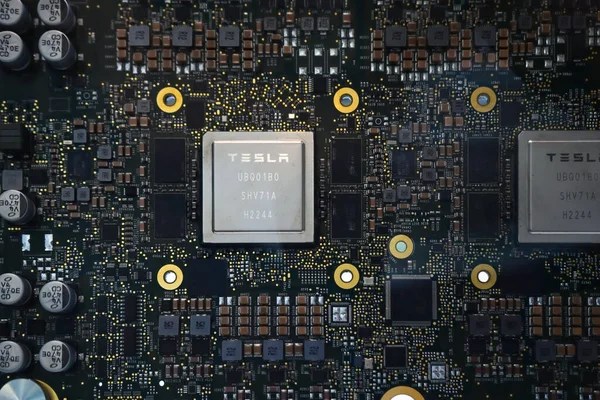
These are not general-purpose processors. Tesla’s AI chips form the backbone of its FSD inference engines in cars and drive the training workloads of its vertically integrated Dojo supercomputer. Musk now says the company will match Nvidia’s annual update cadence, taking a new chip into volume production every 12 months. Already on the roadmap are the AI4, AI5, and forthcoming AI6, the latter being fabricated as part of a $16.5 billion deal with Samsung at its Texas plant. This not only tightens Tesla’s control from silicon design through to software execution but also leverages U.S. semiconductor incentives, diversifying supply chains in the process amid geopolitical uncertainty.
The same philosophy powers Tesla’s chip program from an engineering standpoint: custom silicon optimized for video‑based AI workloads instead of repurposed general‑purpose GPUs. The D1 chip at Dojo’s core delivers 362 teraflops of mixed‑precision performance with 2 TB/s memory bandwidth, arranged in dense training tiles and liquid‑cooled cabinets capable of scaling into the exaFLOP range. This architecture cuts FSD model training cycles from weeks down to under 48 hours, which enables Tesla to issue rapid over‑the‑air safety patches and tune regional driving behaviors. This pipeline supports on-vehicle inference hardware. The most recent Tesla FSD computers reaches sub-20 millisecond perception latency and integrates camera, radar, and LiDAR inputs into a unified transformer backbone. Those chips also drive early versions of the Optimus humanoid robot’s “Bot Brain.”
Robotics experts note that Tesla is re-implementing functionality that established frameworks like ROS 2 already handle much more efficiently. That decision may slow development compared to utilizing community-tested software and specialized robotic processors that deliver up to 7.5× the AI performance of Tesla’s current robot hardware. Musk’s ambitions go far beyond the current production. He has floated targets as high as 200 billion AI chips annually-a production scale that eclipses current output of all other manufacturers combined. Meeting that demand would take a “TeraFab” build-out, leveraging multiple foundry partners including TSMC, Samsung, and potentially Intel. Even with this level of diversification, the sheer manufacturing volume poses daunting challenges to yields, logistics, and energy management. To investors, the technical story is compelling: Tesla is positioning itself as a vertically integrated AI hardware powerhouse, with chips designed for both automotive inference and massive‑scale training.
This could widen its autonomy lead over legacy automakers reliant on external suppliers and outdated architectures. Yet, as the main article points out, Tesla’s current valuation-north of $400 per share-is still driven more by speculative narratives than by reported financial performance. AI hardware leadership might justify premium multiples in the future, but the near‑term fundamentals remain those of a carmaker and battery company. The market’s reaction speaks volumes on the strength of the AI chip narrative as a stock catalyst. Whether Tesla can translate its engineering cadence into sustainable earnings growth will make the difference between whether Monday’s rally is the start of a re-rating-or just another spike in a story-driven chart.


