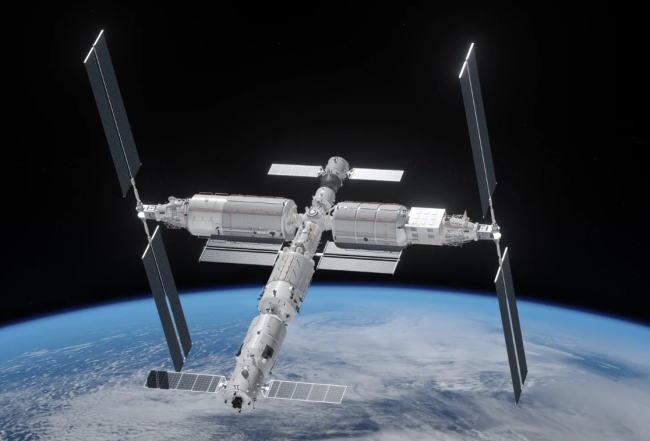
Ten days without a lifeboat in orbit that is the unprecedented situation facing the three astronauts aboard China’s Tiangong space station after their return craft was damaged by space debris earlier this month. This coming Tuesday, on November 25, China plans to launch its Shenzhou-22 spacecraft from the Jiuquan Satellite Launch Center in the Gobi Desert on a mission aimed at restoring the crew’s emergency return capability and stabilizing operations aboard the station.

With a mass of about 8,100 kilograms, Shenzhou-22 will be propelled to a 41.47-degree inclined orbit by a Long March 2F, matching Tiangong’s trajectory at approximately 386 by 391 kilometers in altitude. Instead of being crewed, the spacecraft will be loaded with food and supplies as well as station equipment and will dock autonomously with one of Tiangong’s two Shenzhou-compatible ports. The mission was brought forward from a spring 2026 launch date under China’s “launch-on-need” contingency protocol the first such rapid-response flight in the country’s history of human spaceflight.
The urgency comes from damage to the descent module window of Shenzhou-20, most likely caused by a high-velocity debris impact. According to the China Manned Space Engineering Office, the Shenzhou-20 manned spacecraft’s return capsule window glass had developed a minor crack… thus failing to meet the requirements for a safe crewed return. The outer heat-resistant glass layer was breached and at risk of catastrophic failure during reentry when faced with plasma heating. Consequently, the Shenzhou-20 crew Chen Dong, Chen Zhongrui, and Wang Jie returned to Earth aboard Shenzhou-21 on November 14, leaving the current occupants of the station without a viable evacuation craft.
Yet, in this recovery mission, the critical factor is Shenzhou’s engineering heritage. The three-module configuration of this spacecraft-an orbital module that can fly independently, a reentry capsule for the crew, and a service module housing propulsion and systems-provides operational flexibility. The launch vehicle, Long March 2F, purpose-built for crewed missions, had its safety and reliability honed over the decades. Autonomous docking capability of the orbital module allows Shenzhou-22 to be integrated into Tiangong with no intervention by the crew on board-a critical factor in an uncrewed delivery.
Tiangong itself is a T-shaped, three-module station completed in 2022 that is considered central to China’s long-term human spaceflight ambitions. Designed to support continuous three-person crews, it will host advanced life-support systems, high-capacity solar arrays, and modular docking architecture. Planning is underway for the expansion of the station to a cross-shaped configuration, adding more science racks and extravehicular experiment platforms. Future upgrades include the Xuntian space telescope, a Hubble-class observatory with a 2-meter primary mirror and a field of view 300 times larger than Hubble’s, which can dock with Tiangong for servicing.
China’s crewed program is similarly transitioning to next-generation spacecraft. The partial reusable Mengzhou capsule, in its low Earth orbit configuration, will carry as many as seven astronauts or mixed crew-cargo payloads to Tiangong. A lunar variant, in combination with the Long March 10 rocket, is planned for crewed Moon missions prior to 2030. Such moves are consistent with China’s overall plan of ensuring a perennial on-orbit presence while furthering deep-space flight capabilities.
The launch of Shenzhou-22 underlines the operational resilience in-built into the Chinese space program. The “launch-on-need” readiness of spacecraft and rockets-essentially, keeping them ready to launch quickly-echoes contingency strategies employed by NASA for Skylab and Shuttle missions, as well as by Roscosmos for Soyuz operations. In this instance, it was orbital mechanics that decided the timing, with the precise phasing required between Jiuquan and Tiangong to allow efficient rendezvous.
Once docked, Shenzhou-22 will remain as the station’s primary return vehicle until the arrival of Shenzhou-23 in spring 2026. That mission is expected to carry a fresh crew, possibly including a Pakistani astronaut, marking Tiangong’s first international human spaceflight. China is also preparing for extended-duration missions, with plans for a one-year stay by a single astronaut, and for uncrewed test flights of Mengzhou. For the current crew of Tiangong Zhang Lu, Wu Fei, and Zhang Hongzhang the arrival of Shenzhou-22 will end a rare and risky period without a safe way home. For China’s space program, it represents an ability to rapidly respond to in-orbit contingencies while sustaining momentum toward its long-term goals in low Earth orbit and beyond.