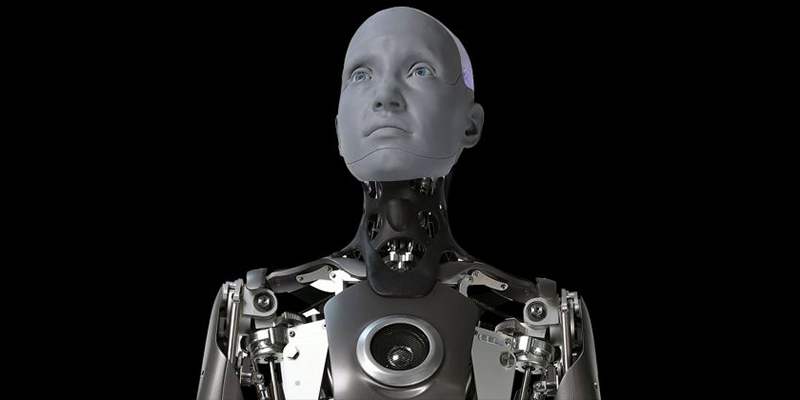
A machine that can dance for a president just days after another collapsed onstage says more about Russia’s AI ambitions than any speech could. That contrast dominated attention in Moscow after Sberbank unveiled its humanoid robot Green to President Vladimir Putin, offering a polished performance that sharply diverged from the high-profile tumble of the country’s other AI‑powered humanoid, Aidol.

Green introduced himself to Putin by saying, “My name is Green. I am the first Russian humanoid robot with embedded artificial intelligence. This means that I am not just a programme on a screen, but a physical embodiment of technology.” Much of the demonstration relied on controlled movement, scripted interaction, and carefully managed distance between robot and president. One of Putin’s guards stood between them, reflecting both security caution and the emerging consensus in robotics that proximity protocols must be built into any machine operating near people. Research on humanoid safety underlines how dynamically stable robots require active control to stay upright-and sudden power cuts can trigger falls; as Aaron Prather noticed, “You can’t really do that with a humanoid.” Developers have turned toward solutions such as controlled deceleration and situational repositioning-including kneeling modes-to avoid hazardous toppling. Already being tested in commercial prototypes such as Digit, which is engineered to initiate a safe state instead of abruptly depowering.
That engineering backdrop loomed larger because the much-discussed humanoid, Aidol from Idol, had fallen during its debut just days earlier. The mishap, shared widely online, brought into sharp focus the fragility of dynamic balance systems when lighting, calibration, and sensor constraints meet. “This is real-time learning, when a good mistake turns into knowledge, and a bad mistake turns into experience.” says Idol’s chief executive, Vladimir Vitukhin, who blamed the fall on calibration issues. Aidol uses 19 servomotors, a 48‑volt battery capable of six hours of operation, and a silicone‑based facial system designed for dozens of emotions and hundreds of micro‑expressions. But its stereo cameras’ sensitivity to stage lighting apparently disrupted orientation, an illustration of how visual‑inertial fusion systems can destabilize when environmental cues shift unexpectedly. After the incident, Idol engineers examined the robot’s balance software-a process consistent with broader efforts in the field to build standards for machines reliant upon actively controlled stability.
While Green did not reveal detailed specifications during the exhibition, Sberbank emphasized future functionality and ongoing software upgrades. The bank said that the robot could perform physical tasks and might later integrate into selected business processes. Such deployments would require solid human‑robot interaction frameworks. Current international working groups, including those at ISO, have been working on rules for robots operating in public-facing environments, focusing on predictable signaling, behavior transparency, and emotional safety considerations.
This follows observations that humans often anthropomorphize humanoids, misjudging their capabilities and letting their guard down in situations that safety experts suggest could best be addressed with standardized cues, clearer design language, and human override. During the visit, Putin also examined the new line of smart ATMs developed by Sberbank, with a camera that measures ten biometric indicators, including pulse and blood pressure, in order to create a summary of a customer’s health condition.
Systems like these are based on multispectral imaging and photoplethysmography methods akin to those found in the health-monitoring kiosks that dot clinics and transit hubs everywhere. Their accuracy hinges on motion compensation algorithms, stable illumination, and calibration against population-level biometric datasets.
These machines reflect a parallel trend in which Russia seeks to embed more sensor‑rich, AI‑enhanced diagnostic tools into everyday services, even as its robotics sector navigates component shortages and sanctions. The contrast of Green’s seamless choreography and Aidol’s fall emphasized how uneven the pace has been in Russia’s push into the embodied AI world. Most companies continue to grapple with engineering, supply chain, and standards‑compliance issues in the sector, even as institutions like Sberbank put on very public displays of confidence.