
Is one of the most obstinate walls between mobile ecosystems finally beginning to crack? Google’s newest update to Quick Share on the Pixel 10 series brings something its users have wanted for a really long time: seamless, direct file transfers with Apple’s AirDrop. For the first time, Pixel owners can send and receive photos, videos, and documents with iPhones, iPads, and macOS devices without resorting to email, cloud links, or third-party apps and without Apple’s cooperation.
Of course, the technical architecture behind this interoperability is worthy of note: Quick Share and AirDrop both use the same short-range wireless protocols, pairing BLE for device discovery with high-speed Wi-Fi Direct for the actual data transfer. Google’s implementation bridges these discovery layers such that a Pixel 10 can recognize an AirDrop-enabled Apple device when it’s set to “Everyone for 10 minutes” mode. Once the handshake occurs, the devices establish a peer-to-peer Wi-Fi Direct link, bypassing any server routing. This ensures zero cloud involvement no content logging, no metadata sharing, no relay through Google or Apple infrastructure.
Security was one of the main pillars in designing the feature. According to Google’s security blog, “This feature does not use a workaround; the connection is direct and peer-to-peer, meaning your data is never routed through a server, shared content is never logged, and no extra data is shared.” The system went through rigorous internal privacy reviews, including commissioned independent penetration testing by NetSPI. Encryption standards for such transfers generally implement WPA2 security over Wi-Fi Direct, providing confidentiality and integrity during transport. Not involving intermediate servers in the architecture also minimizes interception attack surfaces.
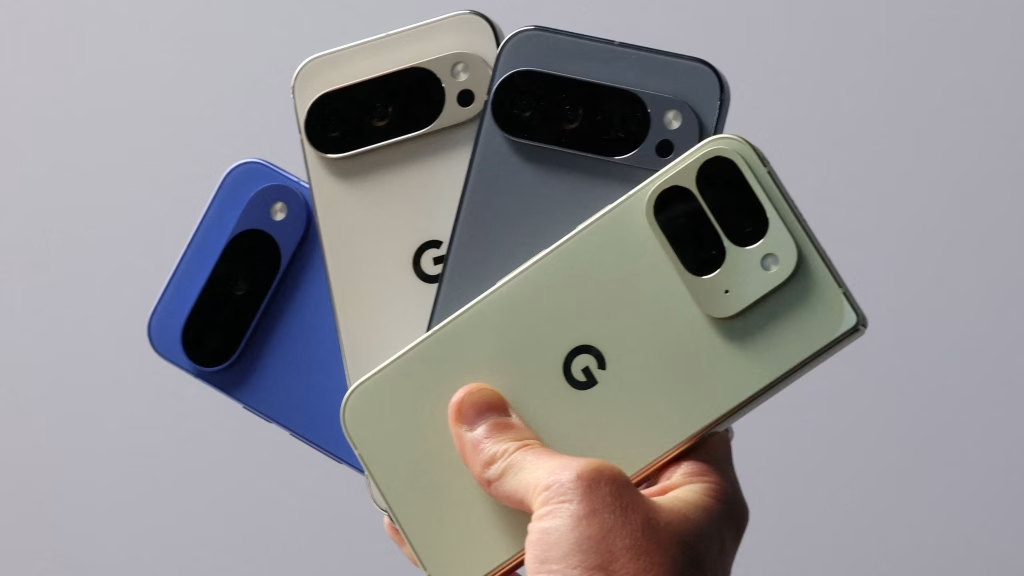
It’s currently a Pixel 10 exclusive, with a spokesperson confirming that “We’re bringing this new experience to Pixel 10 first before expanding to other devices.” On the Apple side, users have to temporarily make themselves discoverable by anyone in their AirDrop settings. That reflects Apple’s default privacy posture, and while the company has said it wants to enable “Contacts Only” mode in future iterations, it would likely require deeper cooperation between Google and Apple.
That move is part of Google’s larger push for cross-platform compatibility. The company earlier this year expanded unknown tracker alerts, introduced last year to detect rogue Bluetooth devices like AirTags, directly within Android’s Safety & Emergency settings. That BLE-scanning system detects trackers separated from their owners and provides maps of their movement alongside options to disable them. It was developed in conjunction with Apple and other manufacturers to create an industry-wide standard of detection.
Google has advocated for cross-platform RCS adoption in messaging. Now, with the inclusion of RCS in Apple’s iOS 18, GSMA’s latest specifications bring end-to-end encryption with the MLS protocol. This allows interoperable encrypted messaging between Android and iOS clients so that text, media, and files stay confidential in transit. RCS also offers the sharing of high-resolution media, group chats, read receipts, and typing indicators-all features that complement the new file transfer capabilities by removing friction from everyday communication.
From an engineering perspective, the AirDrop–Quick Share link is a rare example of reverse interoperability. With neither Apple’s APIs nor any formal collaboration from the company, Google had to reimplement the necessary discovery and connection protocols in a manner that would meet both performance and security expectations. The ability to do that without violating Apple’s security policies mandated absolute adherence to existing wireless standards rather than proprietary hooks. It results in a standards-compliant bridge that’s transparent for end users.
For the Pixel 10 owner, it’s pretty straightforward: Quick Share needs to be enabled, the Apple device needs to be discoverable, then simply select the file and confirm the recipient’s device name to send. On the receiving end, the process is just like native AirDrop prompts, where the approval flow remains intact. The opposite direction isn’t any different, where Pixel devices will need to either be in receive mode or discoverable to all.
While Apple has yet to officially comment, the technical and strategic implications are crystal clear: by allowing direct transfers between two of the most popular mobile ecosystems, Google is improving user convenience and demonstrating how adherence to open wireless standards can erode long-standing platform silos. Added to the advances in cross-platform messaging and tracker detection, this seems to be a deliberate push toward a more interoperable mobile future-one where the brand of the device in question matters less than the connections it can make.


