“The future of AI in the home will be spoken, not typed,” declared Panos Panay during Amazon’s recent hardware event, and the company’s latest Echo lineup seems engineered to prove that point. At the forefront are the Echo Dot Max and the new Echo Studio; each promised tighter integration with Alexa+, Amazon’s generative AI assistant, and delivered substantial hardware upgrades. But after extensive hands-on impressions and technical breakdowns, one emerges as the clear winner, even without Alexa+ activated.
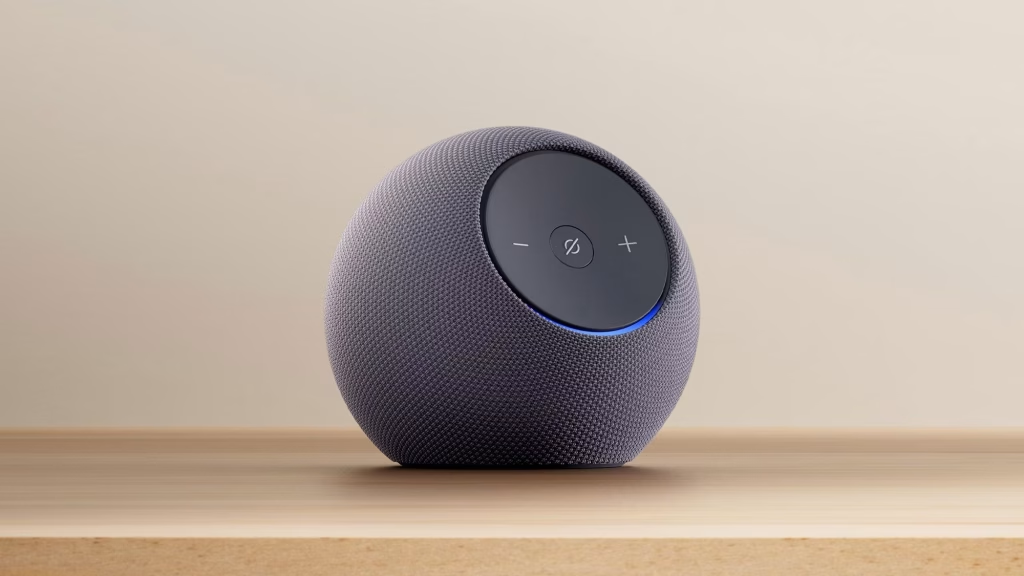
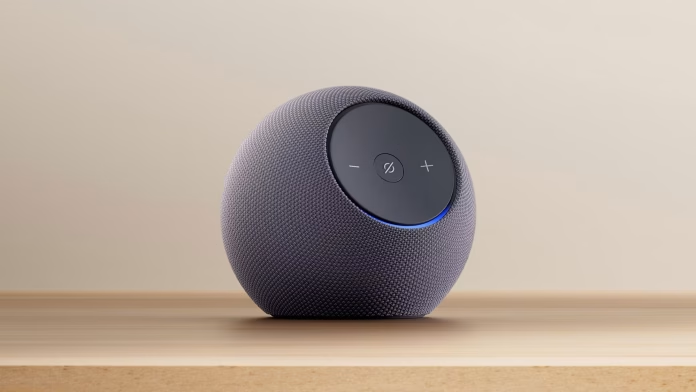
Priced at $99.99, the Echo Dot Max represents Amazon’s most ambitious compact speaker yet. For the first time, this model features an AZ3 chip, which enables a new “AI Accelerator” to work with Alexa+ models coming in the future. The microphone array has been redesigned to detect the wake word up to 50% more accurately a significant leap in far-field voice recognition critical in environments with ambient noise. Its spherical form is wrapped in premium 3D knit fabric, while controls have been moved to enable more emotive interaction cues, from “listening” to “thinking.” In audio performance, Amazon claims twice the power and triple the bass compared to the current Echo Dot-a feat made possible by improved driver tuning and enclosure acoustics.
By contrast, the third-generation Echo Studio targets audiophiles with Dolby Atmos and spatial audio support. It’s powered by the AZ3 Pro chip, offering more robust AI inference for Alexa+. The Studio’s hardware architecture includes multiple drivers and a custom woofer, affording expansive soundstage and depth. But while its premium audio is undeniable, the Studio’s larger footprint and $220 price tag position it for niche use cases, particularly as part of Amazon’s new Alexa Home Theater mode, which can link up to five Echo speakers for surround sound.
Alexa+ integration is where the devices diverge in user experience. The assistant’s “ambient AI” design centers around natural, context-aware conversation, allowing multi-step tasks without rigid commands. On Dot Max, this works fluidly, courtesy of optimizations for edge computing: the AZ3 chip handles local sensor data from Omnisense technologies such as Wi-Fi radar and ultrasound motion detection before syncing with cloud AI. This helps minimize latency and enhances reliability, even for smart home automation. The Studio, while theoretically equally capable, occasionally experiences lag during orchestration of complex routines-a reminder that Alexa+ performance is closely intertwined with hardware tuning.
The bigger engineering narrative here is Amazon’s movement away from cloud-dependent processing toward a more hybrid model. In embedding neural network acceleration within the AZ3 series, the company decreases its reliance on remote servers for immediate tasks and curtails the 10-15 second delays some users report on older hardware. This edge computing approach further enhances privacy, processing certain sensor inputs locally, though it’s worth noting that Amazon did remove the option for fully local voice command processing in March 2025.
In terms of hardware, both devices feature support for Thread, Matter, and Zigbee protocols to control several thousand compatible devices. However, the compact form factor of the Dot Max makes deployment in multiple rooms relatively easier, creating a truly distributed network of AI-enabled nodes. This flexibility aligns with the design philosophy of Alexa+: a frictionless, voice-first utility embedded throughout the home.
Sound quality has improved across the board. The Dot Max punches above its class with its bass boost and refined mids, competing with Apple’s HomePod Mini for clarity of tone. The Studio impresses with its Dolby Atmos renderings, but this advantage is most appreciated in focused listening rather than casual multi-room use. For users valuing AI responsiveness over cinematic audio, the Dot Max’s balance of performance to price and Alexa+ optimization is hard to beat.
Ultimately, while the Echo Studio will yield better sound for purist music or theater uses, the Echo Dot Max emerges as both the more versatile and more future-proof choice. With improved far-field voice recognition, edge AI processing, and the robust smart home integration, it ensures strong performance today and is ready for Alexa+ capabilities in the future.


