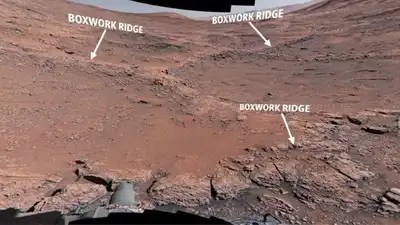
“A big mystery is why the ridges were hardened into these big patterns and why only here,” said Ashwin Vasavada, project scientist for the NASA Curiosity rover, following the mission publishing the first close-up photos of extensive, spiderweb-like boxwork ridges on Mars. These dramatic geological formations, long hidden on the flanks of Mount Sharp in Gale Crater, have become a magnet for planetary scientists who wish to unravel the Red Planet’s past history of water and its promise of long-lost life.
The miles-long boxwork ridges are made up of intercrossing veins of minerals networks of latticework as in some caves on Earth, but orders of magnitude larger. On Earth, boxwork occurs when water tables percolate through rock, dropping minerals that later endure erosion, leaving a rock-hard web of ridges behind. NASA says that on Mars, the process seemed to have proceeded in much the same way, with ancient groundwater seeping through bedrock, dropping minerals that cemented in fissures and cracks. Eons of Martian winds wore away softer rock, revealing these durable mineral networks in bold relief.
What makes the Mount Sharp discovery unique is not only the size, but also the timing. Curiosity’s latest drilling and sampling uncovered veins of calcium sulfate salt minerals also deposited by groundwater embedded inside the boxwork. “These calcium sulfate veins used to be everywhere, but they more or less disappeared as we climbed higher up Mount Sharp. The team is excited to figure out why they’ve returned now,” quoted Abigail Fraeman, deputy project scientist for Curiosity at NASA’s Jet Propulsion Laboratory, in CBS News. The fact that these veins exist in a magnesium sulfate-rich layer that usually forms as water evaporates implies that water had continued to exist beneath the surface even as Mars became more and more dry.
Curiosity’s suite of tools, such as its drill and onboard labs, has allowed for a close-up sampling of these features. The rover’s CheMin instrument, for instance, determines minerals in powdered rock, while ChemCam zaps rocks with a laser to determine their composition. This has uncovered a complicated mineral history in the layers of Mount Sharp. Down lower, the rover found rich deposits of clay minerals and hematite signs of more wet, hospitable conditions. Higher up, the chemistry changes, with increased sulfates and the unexpected return of calcium sulfate veins, suggesting multiple episodes of groundwater circulation and chemical modification in Mars’ history (Mars Rock-Ingredient Stew Seen as Plus for Habitability).
Boxwork formations on Earth are uncommon, most commonly occurring in locations such as Wind Cave, South Dakota. In that one, mineral veins deposited by groundwater have defied erosion, creating honeycomb-like structures on cave walls. The Martian boxwork, nonetheless, is orders of magnitude bigger, and it asks questions regarding the magnitude and longevity of groundwater systems on ancient Mars. This contrast highlights the fundamental distinction between the two planets: whereas Earth’s mineral variety is a result of plate tectonics and the origin of life, Mars’ less diverse mineral set is evidence of a planet on which such activities do not occur or are restricted.
The significance of these mineral veins goes beyond geology. Subsurface breaks permeated by minerals like calcium sulfate, clays, and boron-containing compounds might have offered sheltered microenvironments for microbial existence in ancient Mars. “Early Earth microbes could have survived in a similar environment. That makes this an exciting place to explore,” said Kirsten Siebach, a Curiosity mission scientist at Rice University. This is reinforced by recent modeling, demonstrating that water–rock interaction in Martian subsurface settings is capable of producing chemical energy e.g., hydrogen and methane adequate for fueling microbial metabolisms. The diagnostic minerals saponite and serpentine, byproducts of such reactions, have been identified on Mars and are interpreted as diagnostic of habitable niches.
The find of boxwork ridges and their linked mineral veins on Mount Sharp therefore provides a glimpse into Mars’ active groundwater past that is a rarity. It also presents solid targets for future robotic and, eventually, human exploration. With each layer Curiosity climbs, the story of how water defined the Martian surface and how, in shielded pockets beneath the surface, life may have initially gained a foothold continues to grow.


