“The object’s aphelion the farthest point on the orbit from the Sun is more than 1,600 times that of the Earth’s orbit,” said Sihao Cheng, Institute for Advanced Study lead researcher, as the astronomy community digested the finding of 2017 OF201, a trans Neptunian object whose size and orbit are to redefine our solar system’s edge story. The International Astronomical Union’s Minor Planet Center certified the discovery on May 21, 2025, as a moment when the well known map of our cosmic neighborhood suddenly grew bigger.
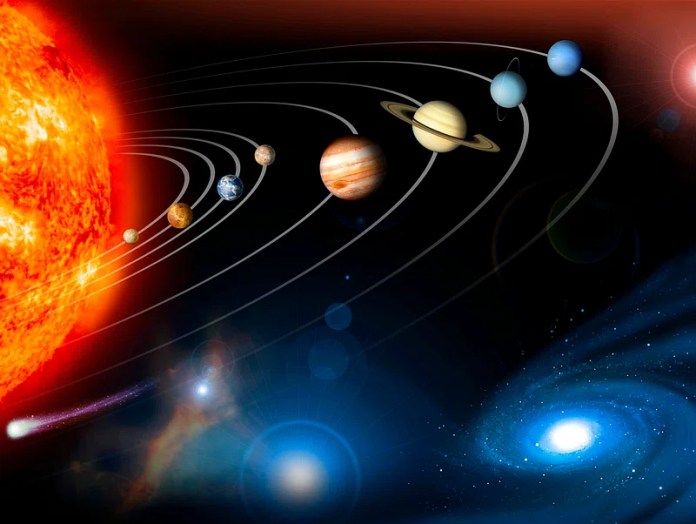
2017 OF201 is no typical far wanderer. With an estimated diameter of around 700 kilometers, placing it potentially as the second largest in such a broad orbit after Pluto, this world is massive enough to be considered a dwarf planet. But it is the form and size of its orbit that really makes it stand out. Whereas Pluto takes only 248 years to make its way around the Sun, 2017 OF201 takes a whopping 25,000 years to complete one orbit, in a path that ranges from a perihelion of 44.5 AU to an aphelion of more than 1,600 AU, well outside even the furthest reaches of the most distant known bodies in the solar system.
This stretched out path, Cheng and his coauthors propose, is a remnant of a stormy past. “It must have experienced close encounters with a giant planet, causing it to be ejected to a wide orbit,” said Eritas Yang of Princeton University (close encounters with a giant planet). The team suggests that 2017 OF201 could have been ejected outward through gravitational interactions, potentially even having spent time in the hypothesized Oort Cloud before being sent back toward the Sun (could have been ejected to the Oort cloud). The Oort Cloud itself, a postulated shell of icy material surrounding the solar system out to 1,000 to 100,000 AU, is unseen save in passing through comets it sends sunward from time to time (Oort cloud’s inner boundary is conjectured to start about 1,000 to 2,000 astronomical units away from our sun).
The discovery of 2017 OF201 was not a case of serendipity but of computational integrity. Cheng’s team used archival photos from the Victor M. Blanco Telescope and the Canada France Hawaii Telescope over seven years and 19 exposures. Sophisticated algorithms combed through the data, linking dim, slowly shifting points of light that gave away the presence of a distant object (detected by identifying bright dots in an astronomy image database). “All the data we used to identify and characterize this object are archival data that are available to anyone, not only professional astronomers,” Jiaxuan Li said, highlighting the democratizing promise of open science.
Perhaps most profoundly, though, is the fact that 2017 OF201’s discovery contradicts the reigning Planet Nine hypothesis. For almost ten years, there has been speculation among planetary scientists about the presence of a large, hidden planet in the outermost region of the solar system, called upon to account for the concentration of some trans Neptunian object (TNO) orbits. This hypothetical world, commonly referred to as Planet Nine or Planet X, is said to have a mass of approximately ten times that of Earth, an orbital distance of 400 to more than 1,000 AU and an orbital period of 10,000 to 20,000 years (mass roughly 10 times that of Earth).
The gravitational shepherding of TNOs where their orbits seem to bunch together in orientation and inclination has been the main evidence put forward for Planet Nine’s existence (clustered together orbits). But 2017 OF201 is a clear outlier. “Many extreme TNOs have orbits that appear to cluster in specific orientations, but 2017 OF201 deviates from this,” Li stressed (breaks that). Its orbit does not fit the expected pattern, raising the possibility that the clustering may not be as robust or as indicative of a hidden planet as once thought. As Li put it on his personal website, “The existence of 2017 OF201 might suggest that Planet 9 or X doesn’t exist.”
The quest for Planet Nine goes on, with fresh searches taking advantage of deep infrared surveys and in the future, the Vera C. Rubin Observatory, that will photograph the sky with never before seen sensitivity and cadence (Vera C. Rubin Observatory starts science operations in July 2025). Recent reports of potential detections in historical infrared data are still unscientific, and as Michael Brown, one of the most vocal supporters of the Planet Nine theory, noted, “I would not believe anything that just had two data points without seeing a third, a fourth, and maybe a fifth and a sixth.”
The 2017 OF201 discovery also opens up the possibility of re-evaluating the population and structure of the outer solar system. The area outside the Kuiper Belt, which for a long time was believed to be practically devoid of material, is now found to contain an unsuspected population of large icy bodies. “2017 OF201 spends only 1% of its orbital time close enough to us to be detectable. The presence of this single object suggests that there could be another hundred or so other objects with similar orbit and size they are just too far away to be detectable now,” Cheng noted (there may be another hundred or so other objects).
The ability technologically to observe so distant an object is a testament to the capabilities of new astronomical surveys and data science. With every advancing telescope and calculating device becoming more powerful, the limits of the known solar system keep moving further away. “Even though advances in telescopes have enabled us to explore distant parts of the universe, there is still a great deal to discover about our own solar system,” Cheng mused (there remains a lot to learn about our own solar system).
The Kuiper Belt and Oort Cloud, which were once thought to be the tranquil periphery of the solar system, are now understood to be dynamic, inhabited realms influenced by old planetary wanderings and gravitational encounters. While Voyager and New Horizons probe deeper outward, and new objects such as 2017 OF201 are discovered, the edge of the solar system becomes increasingly complex and enigmatic.


