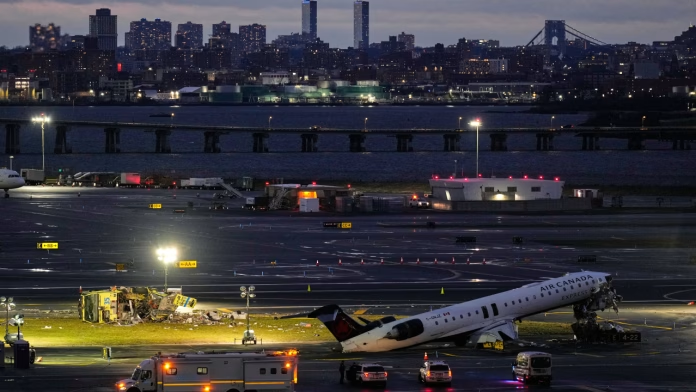
Commercial aviation’s most dangerous moments do not always happen at altitude. In the U.S., 26 Category A runway incidents in the past five years narrowly avoided collisions, a reminder that the thin margin between routine ground movement and catastrophe often depends on communication, visibility and seconds of reaction time.
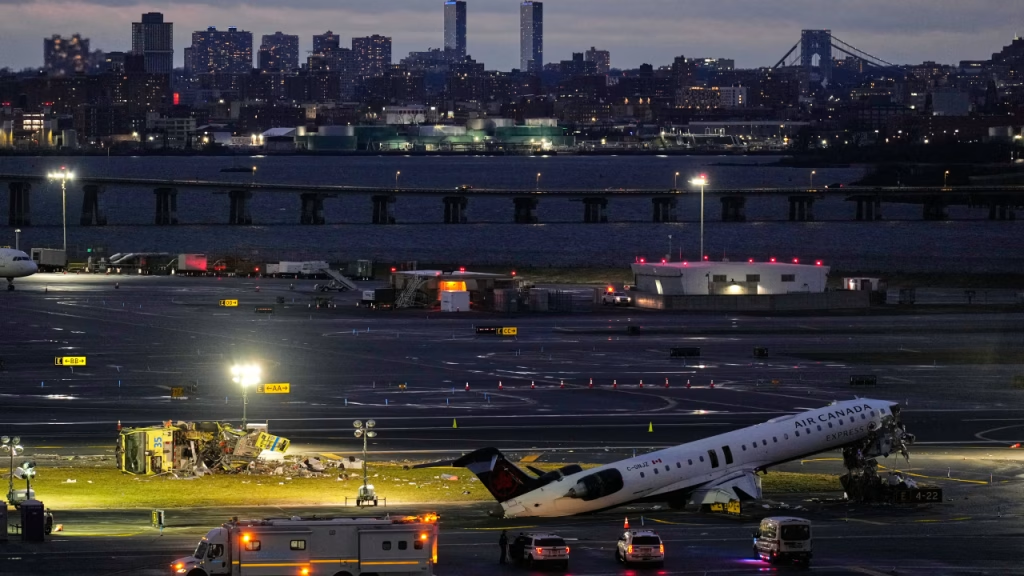
The collision involving an arriving regional jet and an airport fire truck at LaGuardia has pushed one of aviation’s least visible engineering problems into public view: how controllers track aircraft and vehicles moving across a crowded airfield. The issue is not simply whether a tower can see a runway. It is whether the airport’s surveillance tools, vehicle equipment and controller procedures all line up well enough to prevent two authorized movements from occupying the same space.
At the center of that system is ASDE-X, a surface surveillance platform that combines radar, multilateration and satellite-based inputs to show controllers where aircraft and vehicles are moving on runways and taxiways. The FAA says ASDE-X uses radar, multilateration and satellite technology and is designed to reduce the most serious runway incursions. It is especially valuable at night and in poor weather, when visual observation alone becomes less reliable. Controllers are required to use airport surface detection tools to augment, not replace, what they can see from the tower, according to FAA air traffic procedures for ASDE systems.
But surveillance architecture is only as complete as the targets it can identify. Investigators said the runway conflict alert did not activate before the LaGuardia collision because the fire truck lacked a transponder, leaving the system without the full position picture needed for an effective warning. In an NPR interview, NTSB Chair Jennifer Homendy said, “In order for ASDE-X to work well, you have to know where ground vehicles and aircraft are. So in this case, that ground – that vehicle did not have a transponder.” That detail matters beyond a single airport. It points to a design gap between advanced sensing infrastructure and the uneven equipment standards applied to vehicles operating inside active movement areas.
The broader safety record shows why the issue has drawn sustained attention. FAA runway-safety efforts now extend from controller training videos and airport-specific hot-spot graphics to moving-map cockpit displays, taxiway misalignment alerts and lower-cost surface awareness tools for airports without full surveillance coverage. The agency’s newer programs reflect a basic reality: serious runway incursions are rarely caused by one broken component. They tend to emerge from overlapping human and technical failures involving phraseology, workload, airport layout, vehicle access and situational awareness.
That pattern also helps explain why congestion remains such a stubborn risk factor at older airports. LaGuardia operates in tight physical confines and complicated regional airspace, conditions that leave less room for recovery when communication falters or traffic surges after weather delays. Research using FAA runway-incursion data found that operational incidents accounted for 57% of serious incursions between 2021 and 2024, even though pilot deviations were more common overall.
That distinction is important: the gravest close calls often stem from breakdowns in the control system itself, not just mistakes in the cockpit. For airport engineering, the takeaway is direct. Surface safety depends less on a single warning screen than on whether every aircraft, vehicle and controller participates in the same digital picture. When one link is missing, even a modern runway can become an analog risk.


