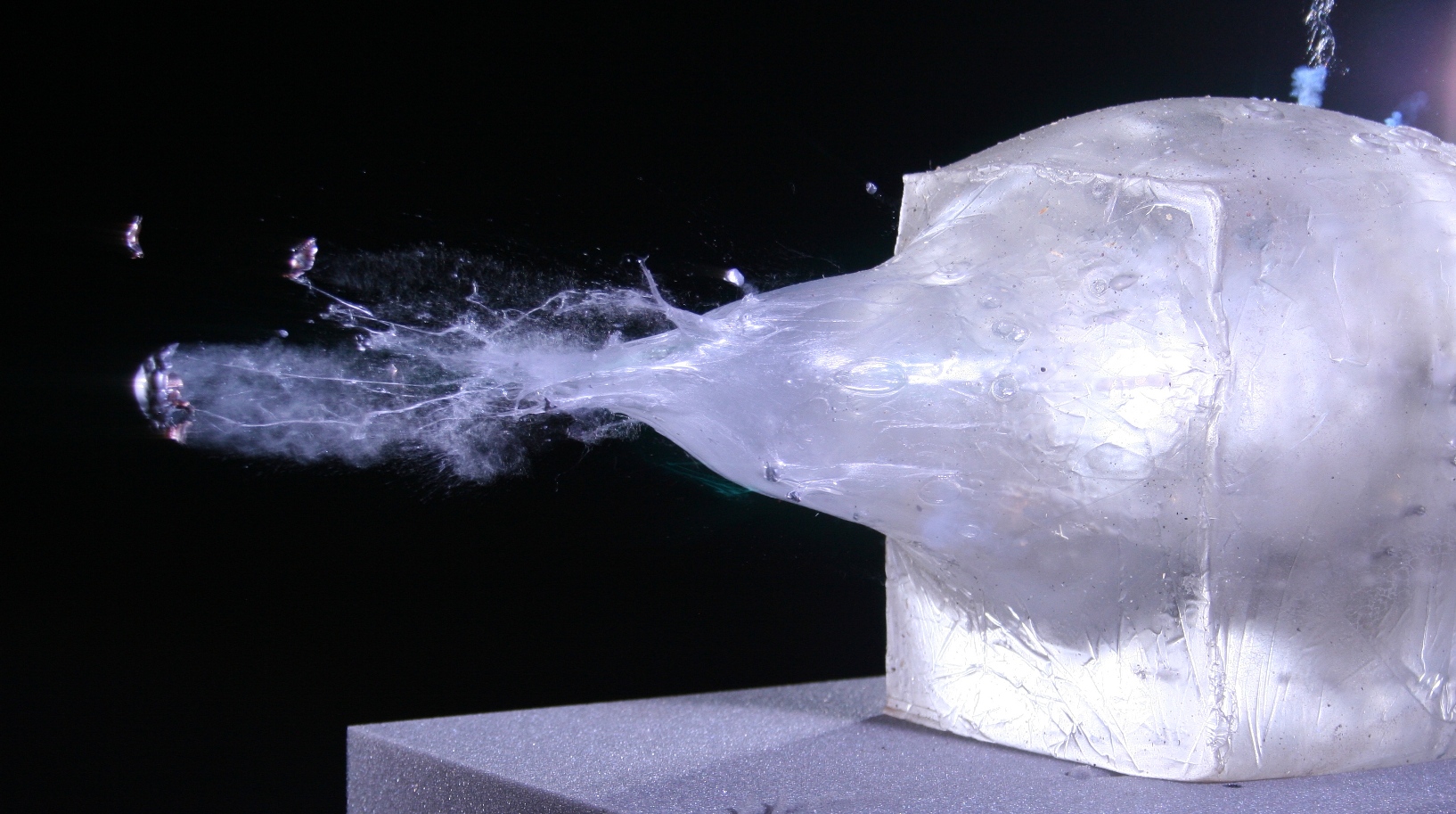
One number changed the language of handgun ammunition: 12 inches. That minimum, paired with an upper ceiling of 18 inches, turned duty-ammo evaluation away from marketing shorthand and toward repeatable terminal-ballistics data.

The shift grew out of the FBI’s post-Miami reassessment of handgun effectiveness, when agents examined why solid hits had failed to end a fight quickly enough. What emerged was not a caliber slogan but a testing framework built around penetration, bullet integrity, and consistency after common barriers. In place of anecdote, the Bureau standardized 10% ballistic gelatin as a tissue simulant and paired it with scenarios meant to reflect the obstacles officers actually encounter.
That structure is what redefined modern duty ammunition. A projectile was no longer judged mainly by velocity figures, muzzle energy, or broad claims about stopping power. It had to perform after heavy clothing, wallboard, plywood, sheet metal, and angled auto glass. The commonly cited six-event protocol used bare gel plus five barrier tests at close range, while earlier FBI development work went even further with additional clothing and auto-glass scenarios. Across those tests, examiners tracked penetration depth, recovered diameter, and retained weight, then judged whether a load could keep working when the ideal shot path disappeared. The emphasis was clear: a service bullet had to reach vital structures from imperfect angles, through intermediate materials, without coming apart or stopping short. That requirement pushed ammunition design toward controlled expansion rather than dramatic but shallow upset.
It also corrected a major design bias from an earlier era. As wound-ballistics researchers argued during the FBI’s late-1980s review, temporary cavity alone was an unreliable guide to incapacitation. American Rifleman preserved one of the era’s defining summaries from Dr. Martin Fackler: “The critical consideration is that the bullet produce its permanent tissue disruption to sufficient depths to insure major vessel disruption from any angle.” That idea made penetration the governing metric, not the visual drama of a fast, light bullet in soft media.
The protocol’s details reinforced the scientific tone. Proper gelatin blocks were validated with a .177 steel BB at 590 fps, and bullets were typically fired from 10 feet into bare gel or through barriers into gel. Loads that failed to reach the minimum were heavily penalized; loads exceeding the practical window also lost favor because uncontrolled pass-through remained a concern. In later scoring guides, penetration accounted for the largest share of the final result, with expansion and retained weight supporting, not replacing, that core measure.
Manufacturers responded by reengineering bullets around the test rather than around brochure claims. Bonded cores reduced jacket separation. Hollow-point cavities were tuned to resist clogging through fabric. Barrier-blind duty projectiles became a distinct class, built to hold together after windshield glass and still track deeply. That work reshaped the reputation of entire calibers. Loads once viewed as marginal improved as bullet construction advanced, and the long-running debate over caliber alone lost some of its force as projectile performance became more consistent.
The broad effect was industrial, not merely tactical. FBI gel testing established a shared benchmark that ammunition makers, law-enforcement agencies, and technical writers could all reference. Modern duty ammunition is defined less by diameter than by whether it can meet a measurable performance envelope under stress. That is the real legacy of the protocol: it turned handgun bullet design into a problem of engineering discipline.